
































PIB Backgrounder
The Mark Behind Consumer Trust
प्रविष्टि तिथि: 05 NOV 2026 2:07PM by PIB Delhi
Hallmarking helps consumers make informed choices by providing assurance about the purity of gold and silver jewellery. The Bureau of Indian Standards (BIS) oversees this system through prescribed standards, digital traceability, and regulatory checks. Since Mandatory gold hallmarking was introduced in 2021, over 65 crore gold articles have received Hallmark Unique Identification (HUID) numbers as of 15 October 2026. The number of BIS-registered jewellers also rose from 43,153 to 2,36,624 during the same period. For silver, while hallmarking remains voluntary, HUID-based marking became mandatory for all hallmarked silver articles on 1 September 2025, with over 90 lakh silver items hallmarked with HUID. Digital verification through the BIS CARE App and continued surveillance help consumers check jewellery details and support greater transparency in the market.
Gold and the Need for Consumer Confidence
For generations, gold has held a special place in Indian households, serving as both a cherished possession and a store of value. Families often buy gold to keep themselves secured against inflation and meet urgent needs by pledging jewellery for loans. However, the purity of gold jewellery is not always easy to determine.
Gold is too soft to withstand wear, so it is alloyed with other metals to make jewellery. While this process is necessary, it can also create opportunities for adulteration and misrepresentation of purity. Moreover, determining the actual gold content becomes even more challenging in intricate jewellery with multiple joints or gold-plated articles. Recognising the need to protect consumers from such practices, the government took steps towards standardising gold products and introducing hallmarking in the country.
What is Hallmarking?
Hallmarking is an important consumer protection measure that certifies the purity of precious metal articles against prescribed standards. It helps consumers make informed purchases and reduces the risk of paying for a higher purity than they receive.
The Hallmarking Scheme: From Voluntary to Wider Coverage
In order to address the regulatory vacuum in the Indian gold market, the voluntary Hallmarking Scheme was launched in 2000. The Bureau of Indian Standards (BIS) was identified as the sole agency to operate the Hallmarking Scheme in India. BIS was entrusted with implementing the scheme to protect consumers against cheating. It was also tasked with developing export competitiveness and helping India emerge as a leading global market for gold jewellery.
The Hallmarking Scheme for silver articles was launched in 2005. At present, gold and silver are covered under the Hallmarking Scheme in India.
For gold jewellery, hallmarking became mandatory from 23 June 2021 in 256 districts. With the expansion of Assaying and Hallmarking Centres, the coverage has now expanded to 392 districts. The hallmarking framework covers 7 gold caratages (fineness in parts per thousand) under IS 1417: 9K (375), 14K (585), 18K (750), 20K (833), 22K (916), 23K (958), and 24KS (995).
While silver hallmarking remains voluntary, any silver article hallmarked under the BIS scheme must bear a mandatory Hallmark Unique Identification (HUID) code as of 1 September 2025. Hallmark Unique Identification (HUID) is a unique six-digit alphanumeric code marked on each hallmarked jewellery article, making it traceable. Under the revised IS 2112:2025 standard, silver jewellery and artefacts can be hallmarked in eight grades of fineness (in parts per thousand): 800 (800.0), 835 (835.0), 900 (900.0), 925 (925.0), 958 (958.0), 970 (970.0), 990 (990.0), and 999 (999.0).
How to Identify Hallmarked Jewellery
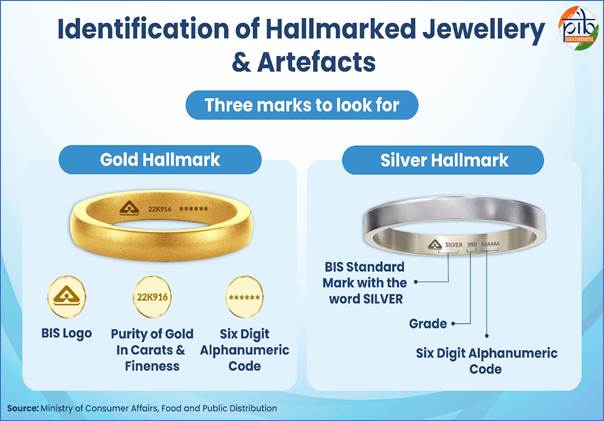
There are three important signs to look for when buying hallmarked jewellery or artefacts:
For Gold Jewellery/Artefacts:
- BIS Standard Mark: the mark displays the BIS logo.
- Purity/Fineness Mark: indicates the purity of the jewellery, for example, 22K916.
- HUID (Hallmark Unique Identification) Code: the unique six-digit identification number assigned to the jewellery.
For Silver Jewellery/Artefacts:
- BIS Standard Mark with the word ‘SILVER’
- Purity/Fineness Mark – indicates the purity, for example, 925
- HUID (Hallmark Unique Identification) Code: the unique six-digit identification number assigned to the article.
Together, these three marks provide greater assurance about the jewellery purchased, because true elegance comes with the assurance of purity.
Hallmarking in Practice: From Request to Verification
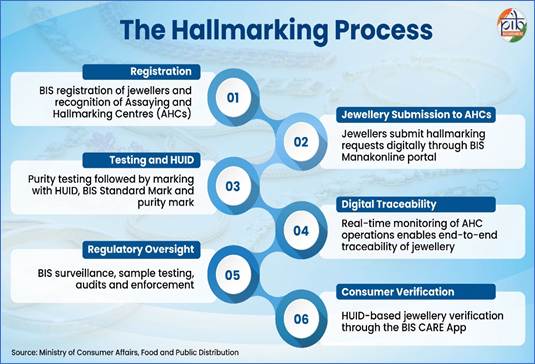
BIS has established a structured process for hallmarking, covering jeweller registration, purity assessment, digital identification and regulatory oversight.
1. Registration and Testing Centres
The hallmarking process begins when jewellers who wish to sell hallmarked jewellery register with BIS. Jewellers can apply online on the National Single Window System (NSWS) portal: https://www.nsws.gov.in/. The portal can be accessed directly or through the BIS portal: https://www.manakonline.in. Registration is granted instantly, free of charge, and remains valid for a lifetime.
Jewellers must then submit their jewellery to a BIS-recognised Assaying and Hallmarking Centre (AHC). AHCs are the testing centres where the jewellery is tested. AHCs receive recognition from BIS after verification of their infrastructure, testing facilities, and qualified personnel.
2. Initiating Hallmarking Requests through the Digital Portal
In order to submit jewellery for hallmarking, jewellers are encouraged to initiate requests through the portal and use its facility for sending jewellery to AHCs. Registered jewellers can log in to www.manakonline.in, select the Hallmarking option, and initiate a request. They enter details such as the jewellery category, quantity, weight, declared purity, and selected AHC before submitting the request.
Alternatively, AHC personnel can initiate requests on behalf of jewellers who submit jewellery without using the portal. This digital process establishes a record of each consignment and supports traceability throughout hallmarking.
3. Testing and HUID Generation
Once the jewellery reaches an Assaying and Hallmarking Centre (AHC), its weight and purity are assessed using the prescribed equipment and procedures.
The machinery and equipment used in the hallmarking process, including weighing balances, X-ray fluorescence (XRF) machines and laser marking machines, must support direct data transfer to centralised software. This enables relevant data generated during the process to be recorded electronically and reduces manual data entry.
API-based integration of XRF machines was implemented with effect from 01 September 2024 to eliminate the possibility of manual entry, accompanied by integrated weighment systems that capture balance readings directly.
After testing, the BIS server generates a unique six-digit alphanumeric HUID code for each jewellery article. The HUID, along with the BIS Standard Mark and the applicable purity mark, is then marked on the jewellery article.
AHCs must also capture photographs of the jewellery article and its hallmark, including the HUID. Under provisions deployed on 08 June 2026, these photographs and weights are uploaded directly to Manak Online.
4. Digital Monitoring and Traceability
BIS provides a provision in the portal for recording the dates and times of activities undertaken at AHCs. These timestamps help in real-time monitoring of operations and assess the time taken from receipt to dispatch of hallmarked jewellery. They also support scrutiny of whether testing occurred before laser marking.
Further, digital initiatives such as automatic weight capture and the Transfer HUID facility strengthen end-to-end traceability in the hallmarking supply chain. The Transfer HUID facility enables jewellers to digitally transfer the unique HUID through the BIS platform whenever gold jewellery changes hands between jewellers or outlets. Phase 1, implemented on 1 June 2026, have provision to transfer HUID when moving gold between corporate jewellers or from any jeweller to a corporate entity, helping prevent duplicate or fraudulent hallmarking.
5. Regulatory Oversight: Checks Beyond the Counter
Digital monitoring complements BIS’s physical surveillance and regulatory checks. BIS periodically visits jewellery sales outlets and randomly samples hallmarked articles for testing against relevant Indian Standards. BIS also conducts periodic surveillance audits to verify whether AHCs continue meeting the prescribed requirements.
It carries out several enforcement activities, including raids, based on complaints/information received on misuse of hallmarks. These actions help in protecting consumers and strengthening trust in the hallmarking system. In 2025-26, more than 30 enforcement activities were conducted against jewellers for such violations.
6. Verify Before You Buy: The BIS CARE App
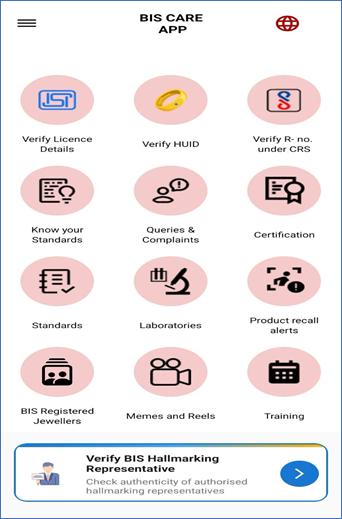

BIS enables consumers to independently verify hallmarked gold and silver jewellery digitally through the BIS CARE App. Consumers can verify a hallmarked article by entering its unique Hallmark Unique Identification (HUID) number.
The app provides details such as the article’s purity, product type, jeweller, and assaying and hallmarking centre. Furthermore, following digital upgrades deployed on 08 June 2026, the app provides access to photographs of the article, its marked hallmark, and automatically recorded weight, allowing buyers to compare the physical item against official records before completing a purchase. The BIS CARE App is available free of charge on Android and iOS and supports 12 languages.
Together, digital traceability, equipment integration and physical surveillance strengthen accountability across the hallmarking system.
Hallmarking at a Glance: Expanding Reach and Awareness
BIS has expanded hallmarking coverage through a growing network of registered jewellers and Assaying and Hallmarking Centres, alongside consumer awareness initiatives.
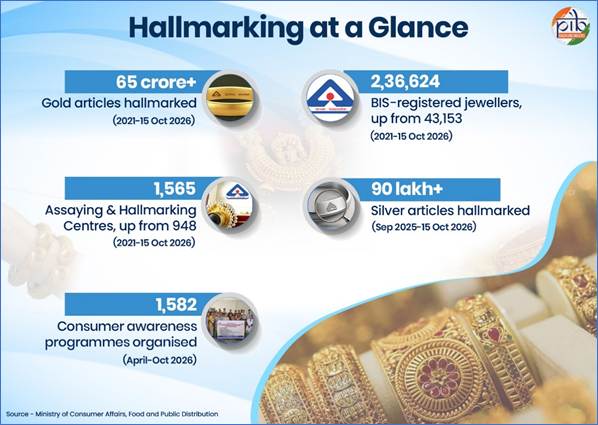
Since the implementation of mandatory gold hallmarking in 2021, over 65 crore gold articles have been hallmarked with HUID as of 15 October 2026. During this period, BIS-registered operative jewellers increased from 43,153 to 2,36,624, while recognised Assaying and Hallmarking Centres (AHCs) grew from 948 to 1,565.
For silver, HUID-based marking was introduced on 01 September 2025 for articles submitted under the voluntary hallmarking scheme, leading to over 90 lakh HUID-hallmarked silver articles.
Consumer awareness remains an important part of this effort. From 01 April to 31 October 2026, BIS Regional and Branch Offices organised 1,582 consumer awareness programmes throughout the country. These programmes included Awareness Programme on Standards under Compulsory Certification, Hallmarking, Gram Panchayat Sensitization programmes etc.
Towards Greater Trust and Transparency
Hallmarking connects the purity of precious metals with the confidence consumers need when making jewellery purchases. Over the years, the system has expanded through wider coverage, technology, and stronger traceability. Unique identification codes help verify jewellery details, while physical surveillance and regulatory checks support accountability. Consumer awareness initiatives further help buyers recognise hallmarked articles and make informed choices. By bringing together technology, transparency and accountability, BIS continues to make trust an essential part of every hallmark.
References
Ministry of Consumer Affairs, Food and Public Distribution
https://www.bis.gov.in/wp-content/uploads/2020/12/brief-on-Hallmarking.pdf
https://www.bis.gov.in/hallmarking-overview/?lang=en
https://www.bis.gov.in/case-studies/bis-hallmark-green-tests-for-yellow-metal/?utm_
https://www.pib.gov.in/PressReleasePage.aspx?PRID=2239540®=48&lang=2
https://www.bis.gov.in/hallmarking-overview/hallmarking-faqs/hallmarking-faq/?lang=en
https://www.pib.gov.in/PressReleaseIframePage.aspx?PRID=1904262®=48&lang=2
https://www.bis.gov.in/wp-content/uploads/2026/07/GuidelinesForAHCs.pdf
https://www.bis.gov.in/wp-content/uploads/2026/06/Guidelines-for-recognition-operation-of-AHCs.pdf
https://www.pib.gov.in/PressReleasePage.aspx?PRID=2088051&lang=2®=48
https://sansad.in/getFile/annex/271/AU2602_qHfqdj.pdf?source=pqars
https://www.pib.gov.in/PressReleasePage.aspx?PRID=2211859®=48&lang=2
PIB Releases/Backgrounders
https://www.pib.gov.in/PressReleasePage.aspx?PRID=1912343®=48&lang=2
https://www.pib.gov.in/PressReleasePage.aspx?PRID=2284432&lang=2®=48
https://www.pib.gov.in/PressReleasePage.aspx?PRID=2207673®=3&lang=1
PIB Research
(रिलीज़ आईडी: 2332987) आगंतुक पटल : 158