





























PIB Backgrounder
Two Years of Collective Action Towards a Child-Marriage-Free India
प्रविष्टि तिथि: 06 NOV 2026 5:33PM by PIB Delhi
|
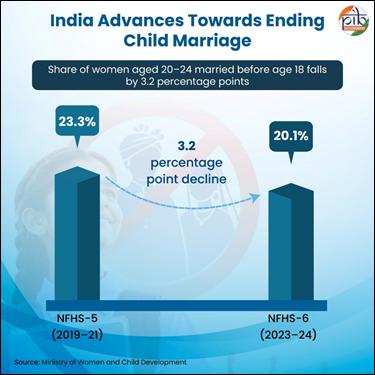
Child marriage remains a persistent social challenge in India, affecting girls’ health, education and future opportunities. However, its prevalence among women aged 20-24 years who got married before the age of 18 has declined from 23.3 per cent in NFHS-5 (2019-21) to 20.1 per cent in NFHS-6 (2023-24). Launched on 27 November 2024, the Bal Vivah Mukt Bharat campaign contributes to strengthening efforts to prevent child marriage through legal safeguards, public awareness and community participation. 6.85 lakh awareness programmes were conducted, 12.47 crore participants were reached and 42.01 lakh pledges were registered. As it completes two years, the campaign continues to advance the national goal of a child-marriage-free India by 2030. |
Towards a Child-Marriage-Free India
Child marriage remains a persistent social challenge in India, even though it is prohibited by law. As per the National Family Health Survey (NFHS-6), 2023-24, 20.1 per cent of women aged 20-24 years were married before the age of 18, down from 23.3 per cent in NFHS-5 (2019-21), a fall of 3.2 percentage points.
The practice exposes girls to serious health risks, particularly from early pregnancy, increases vulnerability to domestic violence, interrupts education, and perpetuates cycles of poverty and gender inequality.
India’s response has therefore been layered: a law that prohibits and punishes, a scheme that changes how girls are valued, and, since November 2024, Bal Vivah Mukt Bharat (BVMB), a national campaign that brings the two together in community action.
The Prohibition of Child Marriage Act, 2006 (PCMA)
The legal answer to this challenge is the Prohibition of Child Marriage Act, 2006, the statutory foundation for action against child marriage. It replaced the Child Marriage Restraint Act, 1929 (Sarda Act), shifting the legal approach from merely restraining child marriage to prohibiting it, while offering stronger protection and relief to victims.
Who is a “child”:
A male who has not completed 21 years of age and a female who has not completed 18 years of age. A child marriage is one in which either contracting party is a child.
Status of the marriage:
A child marriage is voidable at the option of the party who was a child, who may petition the District Court, generally within two years of attaining majority. It is void in specified circumstances, such as where the child has been trafficked, taken by force or deceit, or used for immoral purposes.
Offences and penalties:
Offences under the Act are cognizable and non-bailable. An adult male marrying a child, and persons who solemnise, perform, abet, promote or attend a child marriage (including parents and guardians), are liable to rigorous imprisonment of up to two years and/or a fine of up to ₹1 lakh. Women offenders are not liable to imprisonment.
Relief for victims:
The Act provides for maintenance, residence and custody arrangements, and the children of such marriages remain legitimate.
Prevention through injunctions:
Judicial Magistrates are empowered to issue injunctions to stop an impending child marriage. District Magistrates and Child Marriage Prohibition Officers play an important role in prevention, particularly during mass marriage occasions and festivals such as Akshaya Tritiya. They do so through timely intervention, awareness and coordination with local authorities.
Child Marriage Prohibition Officers (CMPOs):
Section 16 of the Act empowers State Governments to appoint CMPOs by notification in the Official Gazette. Their statutory duties include preventing the solemnisation of child marriages, collecting evidence for prosecution, counselling individuals and communities, creating awareness, sensitising communities, and furnishing periodic returns and statistics. Effective implementation therefore demands not only enforcement after a violation, but also preventive outreach, community vigilance and prompt intervention before a marriage takes place.
|
Supreme Court Framework: In its judgment dated 18 October 2024 in Society for Enlightenment and Voluntary Action & Another v. Union of India & Others (W.P. (C) No. 1234 of 2017), the Hon’ble Supreme Court issued a comprehensive framework for States and Union Territories. It emphasised dedicated, full-time CMPOs at district and sub-district levels. It also emphasised special units for coordination, monitoring and grievance redressal, multi-sectoral awareness campaigns, and training of key functionaries. Technology-enabled reporting and databases of areas at risk were also emphasised. The judgment shifts the focus decisively from punishment towards prevention, protection and empowerment. Yet law alone cannot change the social norms that sustain the practice, which is where the education and empowerment of girls come in. |
Beti Bachao Beti Padhao (BBBP)
While law prohibits child marriage, Beti Bachao Beti Padhao (BBBP) works to change the social attitudes that sustain it. BBBP was launched on 22 January 2015, to address the Child Sex Ratio and the wider empowerment of girls and women across the life cycle.
BBBP is a multi-sectoral initiative led by the Ministry of Women and Child Development as the nodal ministry. It works in collaboration with the Ministry of Health and Family Welfare, Ministry of Education, Ministry of Skill Development and Entrepreneurship, and Ministry of Minority Affairs. The scheme is implemented as a component of Mission Shakti. It focuses on awareness generation, advocacy, community mobilisation and behavioural change. It also promotes the survival, protection and education of the girl child.
Prevention of child marriage is closely linked to these objectives. Promoting girls’ education, addressing school dropouts, challenging discriminatory social norms and encouraging families to value the girl child all help to delay marriage and widen opportunities for adolescent girls.
BVMB builds on this foundation by adding a sharper operational focus on child marriage and a coordinated statutory and community-level response. It is this coming together of the law, the scheme and community action that gave rise to the national campaign.
A Collective Commitment to End Child Marriage
Drawing on the legislative framework and the community focus of BBBP, the Ministry of Women and Child Development (MWCD) launched the national BVMB campaign on 27 November 2024 with the objective of making India child-marriage-free.
It brought together Government institutions, State and Union Territory administrations, local bodies, educational institutions, frontline workers, civil society organizations, faith leaders, youth and citizens around a common national commitment. The campaign seeks to strengthen community-level prevention, improve public access to CMPOs, increase reporting of child marriage, and support girls at risk.
The campaign aims to reduce the prevalence of child marriage and to make India child-marriage-free by 2030, in line with Sustainable Development Goal (SDG) Target 5.3. MWCD has committed to fully funding the campaign, giving priority to 257 high-burden districts identified through NFHS-5 data, where the prevalence of child marriage is at or above the national average.
BVMB Portal: Connecting Citizens with Action
The BVMB Portal (https://stopchildmarriage.wcd.gov.in) has been developed as the digital backbone of the campaign, providing a centralised platform for the effective implementation, monitoring and outreach of BVMB.
The portal makes details of Child Marriage Prohibition Officers (CMPOs) accessible to the public. It facilitates the reporting of child marriage incidents. States, Union Territories and field functionaries can also record awareness activities and community mobilisation efforts.
The portal also provides a platform for citizens, institutions and public representatives to take the BVMB pledge, the pledge initiative also being facilitated through MyGov. Thus, the portal serves as both a citizen-facing platform for information and reporting and a monitoring mechanism to track the campaign’s progress and implementation across the country.
100-Day Special Awareness Campaign
To intensify national effort at the end of the campaign’s first year, MWCD launched a 100-Day Intensive Awareness Campaign on 4 December 2025 at Vigyan Bhawan, New Delhi, accompanied by a synchronised national pledge-taking ceremony.
Implemented from 27 November 2025 to 8 March 2026 across all States and Union Territories, it moved in three spells from general awareness to targeted institutional engagement and, finally, to community-level commitment.
|
Spell and period |
Focus group |
Key activities |
|
Spell I 27 November to 31 December 2025 |
Schools, colleges and universities |
Awareness and sensitisation sessions, debates, essay competitions, interactive activities and pledge ceremonies |
|
Spell II 1 to 31 January 2026 |
Religious institutions, faith leaders, community influencers and marriage-related service providers |
Engagement with temples, mosques and other places of worship; outreach to caterers, tent houses, DJs and other service providers; display of Information, Education and Communication (IEC) material |
|
Spell III 1 February to 8 March 2026 |
Gram Panchayats and Municipal Wards |
Community mobilisation and facilitation of resolutions declaring Panchayat/Ward jurisdictions child-marriage-free |
The campaign was implemented through coordinated efforts of the Central Ministries and Departments, State and Union Territory Governments, district administrations and various institutional and community-level stakeholders. The emphasis was on strengthening the role of CMPOs, mobilising local institutions and ensuring active community participation in preventing child marriages.
States and Union Territories were encouraged to undertake awareness and outreach activities, involve Panchayati Raj Institutions and Urban Local Bodies, and strengthen monitoring at the district and grassroots levels.
Bal Vivah Mukt Bharat: Key Achievements
The BVMB Campaign has contributed to strengthening the national effort to eliminate child marriage through sustained awareness generation, institutional mobilisation, community participation and preventive action. The key achievements of the campaign are as follows:
1. Extensive Awareness and Community Outreach
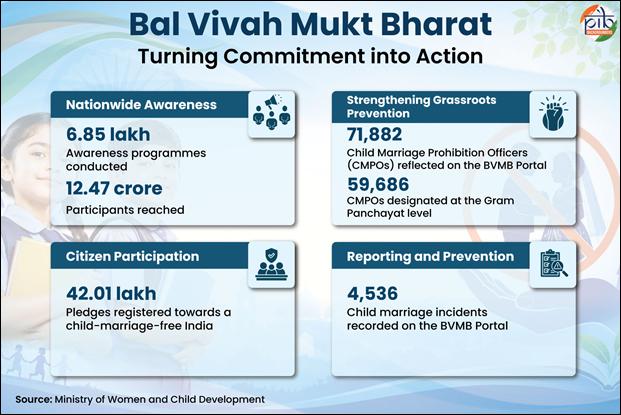
- 6.85 lakh awareness programmes conducted across the country.
- 12.47 crore participants reached through awareness and mobilisation activities.
- The 100-Day Awareness Campaign provided a structured framework for engagement with educational institutions, students, religious leaders, marriage-related service providers, Panchayati Raj Institutions, Urban Local Bodies and local communities.
2. Strengthening of the Institutional Framework
- 71,882 Child Marriage Prohibition Officers (CMPOs) reflected on the BVMB Portal.
- 59,686 CMPOs designated at the Gram Panchayat level, strengthening the reach of the prevention mechanism at the grassroots.
- The portal provides a centralised platform for accessing CMPO details and monitoring awareness and preventive activities across States and Union Territories.
3. Increased Citizen Participation
- 42.01 lakh pledges registered through the BVMB Portal and MyGov, comprising 40.96 lakh pledges through the BVMB Portal and 1.05 lakh pledges through MyGov.
- The pledge initiative has provided citizens, institutions and public representatives an opportunity to affirm their commitment towards a child-marriage-free India.
4. Reporting and Preventive Action
- 4,536 child marriage incidents recorded on the BVMB Portal.
- Focused interventions during high-risk periods, including Akshaya Tritiya, have involved district administrations, CMPOs, law enforcement agencies and community stakeholders in efforts to prevent child marriages through timely intervention and coordinated action.
Convergence with Central Ministries and Departments, State and Union Territory Governments, district administrations and grassroots institutions has strengthened the whole-of-government and whole-of-society approach towards eliminating child marriage.
The portal supports mapping and public access to CMPO details, incident reporting, recording of awareness activities, monitoring of local mobilisation and online pledge-taking. Together, these functions promote transparency, timely reporting, evidence-based monitoring and follow-up.
Progress Across States and Union Territories
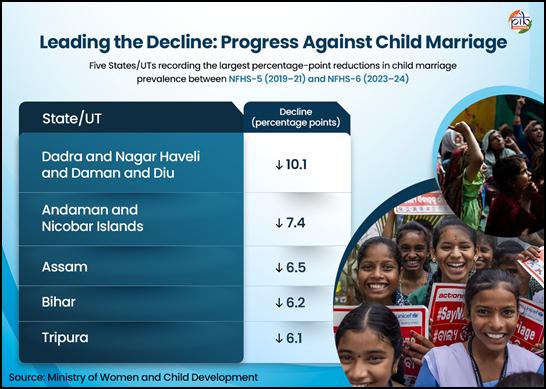
The national prevalence declined from 23.3 per cent in NFHS-5 (2019-21) to 20.1 per cent in NFHS-6 (2023-24). Most States and Union Territories show a decline since NFHS-5. Dadra and Nagar Haveli and Daman and Diu registered the largest reduction of 10.1 percentage points, followed by Andaman and Nicobar Islands (7.4 percentage points), Assam (6.5 percentage points), Bihar (6.2 percentage points) and Tripura (6.1 percentage points). 28 States and Union Territories are doing better than the national average, including Karnataka,
Uttar Pradesh, Tamil Nadu, Mizoram and Keralam.
Two Years of Bal Vivah Mukt Bharat
The National Observance on 27 November 2026 marks two years of the BVMB campaign. Against this backdrop of stronger legal machinery, wider community participation and growing data, it provides an occasion to take stock of progress, recognise the contribution of CMPOs and grassroots stakeholders, share replicable practices from States and Union Territories, and renew the national commitment to prevention.
The continuing focus is on strengthening dedicated CMPO arrangements, improving the quality and completeness of portal data, expanding awareness and pledge mobilisation, and ensuring timely reporting and preventive intervention. It also includes deepening the participation of Panchayats, urban local bodies, educational institutions, families, faith leaders, youth and civil society.
The NFHS figures show that prevalence is falling but unevenly across States, which is why this effort must be sustained. It remains aligned with the national objective of a child-marriage-free India by 2030 and SDG Target 5.3.
References
Ministry of Women and Child Development
****
PIB Research
(रिलीज़ आईडी: 2333696) आगंतुक पटल : 191