



Ministry of Fisheries, Animal Husbandry & Dairying
National Workshop on Seafood Exports at Visakhapatnam, Andhra Pradesh Convened by the Department of Fisheries in Collaboration with Ministry of Commerce & Industry
In the gracious presence of Hon’ble Chief Minister, Andhra Pradesh; Hon’ble Minister of Commerce & Industry; Hon’ble Minister of Fisheries, Animal Husbandry & Dairying; Hon’ble Minister of Civil Aviation and Hon’ble Minister of Food Processing Industries
Charting comprehensive roadmap for strengthening India’s seafood export ecosystem
Posted On: 05 JUN 2026 7:29PM by PIB Delhi
A National Workshop on Seafood Exports was convened by the Department of Fisheries, Ministry of Fisheries, Animal Husbandry and Dairying, in collaboration with the Ministry of Commerce and Industry, with support from the Government of Andhra Pradesh, on 5th & 6th June 2026 in Visakhapatnam, Andhra Pradesh, to chart a comprehensive roadmap for strengthening India’s seafood export ecosystem across States and stakeholders. The event was graced by Shri Nara Chandrababu Naidu, Hon’ble Chief Minister, Andhra Pradesh; Shri Piyush Goyal, Hon’ble Minister of Commerce & Industry; Shri Rajiv Ranjan Singh, Hon’ble Minister of Fisheries, Animal Husbandry & Dairying and Panchayati Raj; Shri Kinjarapu Rammohan Naidu, Hon’ble Minister of Civil Aviation, GoI; and Shri Chirag Paswan, Hon’ble Minister of Food Processing Industries, GoI.
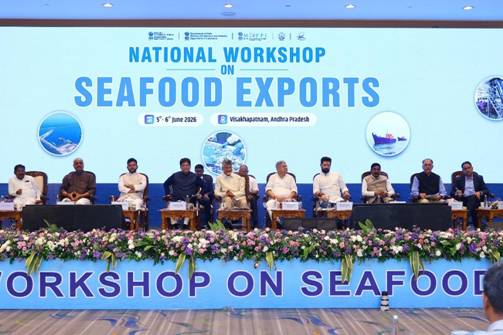
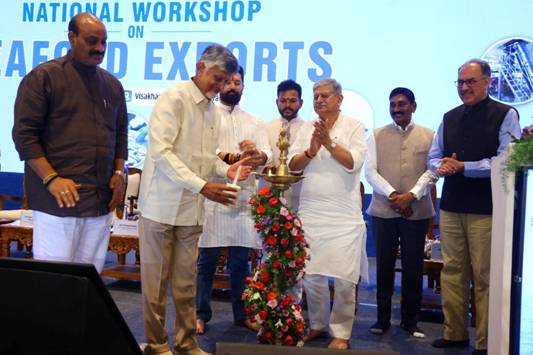
The workshop brought together senior officials from the Central Government, along with representatives from States and Union Territories. Key national institutions, including the Marine Products Export Development Authority (MPEDA), Export Inspection Council (EIC), National Fisheries Development Board (NFDB), NABARD, NCDC, NCEL, SFAC and Invest India, participated. The workshop also witnessed the presence of seafood exporters, industry associations, processors, start‑ups, and other value‑chain stakeholders, ensuring comprehensive representation of the seafood export ecosystem.
Shri. Nara Chandrababu Naidu, Hon’ble Chief Minister, Andhra Pradesh highlighted that the Blue Economy will be a key driver of future economic growth, with the fisheries sector playing a transformative role. He underscored Andhra Pradesh’s leadership in fisheries production and exports and expressed confidence that India can significantly scale up its global market share through value addition, innovation, and stronger export ecosystems. Emphasising quality, sustainability, traceability, and circular economy practices, he called for a collaborative approach involving all stakeholders to build a globally competitive and trusted Indian seafood brand, while assuring full support from the State to promote investment, infrastructure, and a robust aquaculture ecosystem.
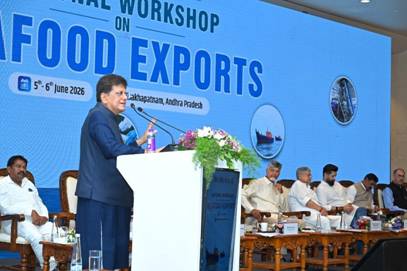
Shri. Piyush Goyal, Hon’ble Minister, Ministry of Commerce & Industry, GoI, emphasised the need to embrace innovation and adopt advanced technologies to fully harness the potential of India’s fisheries and aquatic resources. He highlighted the Government’s vision to position India as a globally trusted seafood brand, known for quality, sustainability, traceability and value addition, and underscored the importance of collective efforts to enhance competitiveness in global markets. He further stated that strengthening export infrastructure would be a priority, including consideration for establishment of quarantine and allied facilities at key locations such as Visakhapatnam and other major centres, to facilitate seamless trade and ensure compliance with international standards.
Shri Rajiv Ranjan Singh, Hon’ble Minister for Fisheries, Animal Husbandry & Dairying and Panchayati Raj, Government of India, Shri Rajiv Ranjan Singh, Hon’ble Minister, highlighted that the fisheries sector has witnessed significant growth, with production and exports more than doubling over the past decade to 197 lakh tonnes and over ₹73,000 crore. He noted that while inland fisheries contribute a major share of production, their low export share presents a key opportunity and directed that a standardised SOP be developed to promote exports from inland States. The Minister underscored sustainability initiatives including TEDs, marine mammal comparability, and EEZ and High Seas regulations, and highlighted continued focus on island regions and the EEZ Access Pass for export‑oriented development.
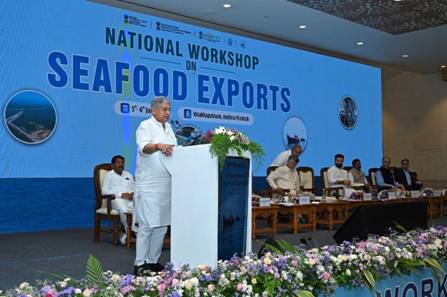
He further announced that under the Pradhan Mantri Matsya Sampada Yojana (PMMSY), the Government of India has approved development of a Smart and Integrated Fishing Harbour at Kakinada, Andhra Pradesh, at an outlay of ₹72.42 crore with central assistance of ₹43.45 crore, incorporating modern infrastructure and smart technologies to enhance efficiency and service delivery. On completion, the harbour will provide berthing facilities for about 423 vessels, cater to annual landings of around 74,448 tonnes, and generate employment for approximately 12,345 people, contributing significantly to the holistic development of the fisheries sector in the State. He emphasised that the second phase of PMMSY is aligned towards export‑oriented development and stressed the need to strengthen export infrastructure.
Shri. Kinjarapu Rammohan Naidu, Hon’ble Minister of Civil Aviation, GoI, emphasised a whole‑of‑government approach to strengthen seafood exports, highlighting the critical role of efficient logistics, cargo infrastructure, and global connectivity. He appreciated stakeholders for navigating challenges and stressed the need to ensure timely and cost‑effective delivery of seafood products to global markets, while maintaining high standards of quality and safety. The Minister highlighted ongoing efforts to strengthen air cargo networks, develop dedicated cargo hubs, improve multimodal logistics, streamline transhipment processes, and promote initiatives such as “One Airport, One Product”, aimed at reducing time and costs and enhancing export competitiveness.
Shri. Chirag Paswan, Hon’ble Minister, Ministry of Food Processing Industries, GoI emphasised that seafood exports are of critical importance for India and the entire fisheries value chain, appreciating the efforts of stakeholders in sustaining growth despite challenges. He highlighted the need to shift from “volume to value” and “produce to product”, with a strong focus on value addition and development of global markets alongside domestic markets. Noting the vast untapped potential of the fisheries sector, he underscored opportunities in ready‑to‑eat and ready‑to‑cook segments, which are witnessing growing global demand. The Minister called for strengthening the food processing ecosystem and value chains, addressing misconceptions around processed foods, and ensuring quality and purity to enhance global perception of Indian products. He also stressed the role of technology in improving shelf life and encouraged active participation of industry stakeholders to position India as a global food basket.
Dr. Abhilaksh Likhi, Secretary (Fisheries), Department of Fisheries, MoFAH&D, set the context for the workshop and emphasised the need for a coordinated institutional response to strengthen India’s seafood export ecosystem, highlighting that sustained inter‑ministerial efforts and stakeholder engagement have enabled India to achieve record export performance despite global headwinds. He drew attention to structural gaps in export orientation, particularly in inland fisheries, and stressed the need for targeted investments in infrastructure, certification systems, and market access mechanisms. The Secretary also highlighted emerging opportunities in island ecosystems and offshore resources, and underscored the role of cluster‑based development, innovation, and MSME participation under PMMSY‑II to enhance value realisation and competitiveness.
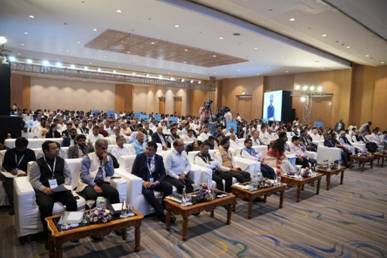
During the deliberation, stakeholders highlighted challenges across the fisheries value chain, including disease management and need for disease‑resilient broodstock, rising input costs, particularly fish meal, and limited access to quality seed and quarantine facilities. Concerns were raised on logistics and infrastructure gaps, especially the need for improved transportation, cold chain, air cargo support, and satellite processing facilities for inland regions. Export‑related issues such as stringent certification requirements (especially EU standards), antibiotic compliance, and need for traceability were also emphasised. Stakeholders underscored the importance of adoption of new technologies, diversification of markets, development of value‑added products, and strengthening of Coldwater and high‑value species segments such as trout. There were requests to address juvenile fishing, promote sustainable practices, and reduce dependence on exports of raw produce by building robust domestic processing and export‑oriented value chains.
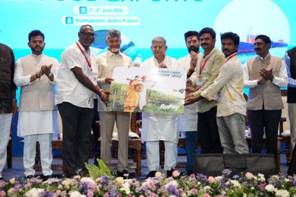
Benefits were also distributed under the Pradhan Mantri Matsya Kisan Samridhi Sah-Yojana (PMMKSSY), Kisan Credit Cards (KCC), and other initiatives. Aqua Insurance was given to Shri Parupalli Baswanth Chowdary, Krishna, Andhra Pradesh, Smt. Pushpalatha Nyathri, Krishna, Andhra Pradesh, Smt. Polisetty Devi Srilakshmi, West Godavari, Andhra Pradesh, Shri Inti Premanandam, West Godavari, Andhra Pradesh, Shri Polisetty Murali, West Godavari, Andhra Pradesh.
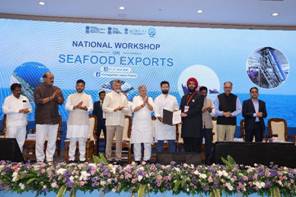
Presentations were made by Ministries, Departments and key industry stakeholders on measures undertaken for promotion of seafood exports, including related schemes, policies and future roadmap. Presentations were delivered by the Department of Fisheries, Department of Commerce, DPIIT, Ministry of Food Processing Industries, Export Inspection Council and Department of Fisheries, Gov. of Madhya Pradesh, outlining initiatives on export development, quality compliance and value addition. This was followed by presentation from, Seafood Exporters Association of India (SEAI), Indian Fishmeal and Fish Oil Exporters’ Association (IFAFEA), and Indian Marine Ingredients Association (IMIA), highlighting industry perspectives, challenges and opportunities for strengthening India’s seafood export ecosystem.
As India charted its path towards ₹1 lakh crore in seafood exports, the workshop marked the beginning of a new phase of innovation, integration, and global leadership. The outcomes of the workshop are expected to catalyse a future‑ready, competitive and inclusive seafood export ecosystem, positioning India as a trusted leader in global markets.
******
JP
(Release ID: 2269489) Visitor Counter : 214