



Ministry of Housing & Urban Affairs
National Institute of Urban Affairs marks 50 years of shaping India’s urban transformation
Golden jubilee celebrations held at Vigyan Bhawan under the theme ‘Resilient Urban India @2047’
As cities face growing climate-related stresses, future urban development must focus on proactive planning, nature-based solutions, green infrastructure and sustainable systems : Dr P K Mishra
The National Urban Learning Platform launched as the urban arm of iGOT-Mission Karmayogi
Posted On: 13 JUN 2026 6:20PM by PIB Delhi
The National Institute of Urban Affairs (NIUA), a premier think tank under the Ministry of Housing and Urban Affairs, Government of India, marked 50 years of its work in supporting integrated and sustainable urban development at Vigyan Bhawan, New Delhi, today.
The golden jubilee celebrations were organised under the theme ‘Resilient Urban India @2047’ and brought together over 1,000 participants, both online and offline. The event was attended by national and international delegates, senior officials of the Government of India and state governments, policymakers, urban practitioners, researchers, development partners and representatives from institutions working on India’s urban transformation.
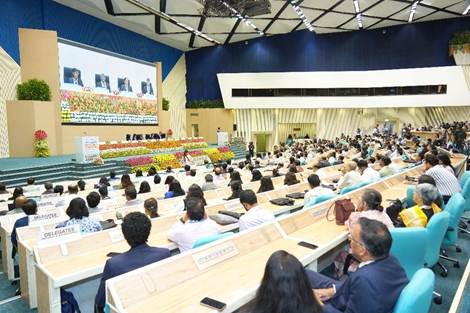
Dr P. K. Mishra, Principal Secretary to the Hon’ble Prime Minister, attended the event as Chief Guest and commended NIUA on completing 50 years of service to India’s urban sector. He said, “As cities face growing climate-related stresses, future urban development must focus on proactive planning, nature-based solutions, green infrastructure and sustainable systems.”
Shri Srinivas Katikithala, Secretary, Ministry of Housing and Urban Affairs, noting NIUA’s contributions to the urban sector over the past half-century, said, “India’s journey towards Viksit Bharat @2047 requires cities to be planned not only for growth, but also for resilience, sustainability and long-term adaptability.”
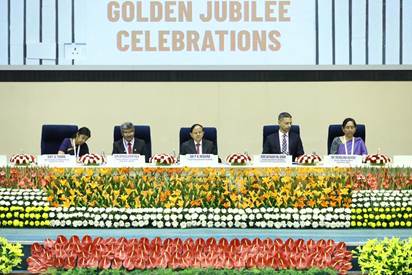
Shri Satinder Pal Singh, Additional Secretary, Ministry of Housing and Urban Affairs and Vice President, NIUA, said, “The urban challenges of the next 50 years will be different in kind and scale, and will require stronger institutions, sharper knowledge and the capacity to adapt.”
Dr Debolina Kundu, Director, NIUA, said, “For the past 50 years, NIUA has served as a bridge between research, policy and practice, and between national priorities and local realities.”
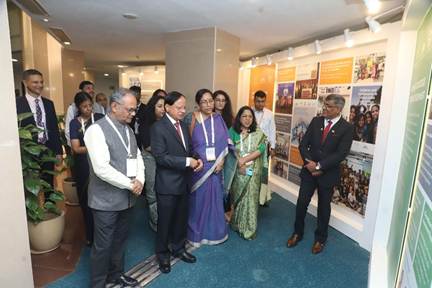
The event commenced with an exhibition that chronicled NIUA’s five-decade journey and its contributions to India’s urban sector. The exhibition presented key milestones, landmark studies, policy support, capacity-building initiatives, partnerships and knowledge products that have shaped the Institute’s work since 1976.
The event marked the launch of key publications and initiatives to strengthen urban resilience, capacity building and evidence-based policymaking. These included ‘Vision for a Resilient Urban India: Building Sustainable and Future-Ready Cities,’ which outlines strategies for resilient urban development across planning, housing, construction, water and mobility, and ‘Understanding the New Geography of India’s Urbanisation: A Geospatial Approach,’ which presents a Modified DEGURBA framework to support improved settlement classification and urban governance.
A commemorative publication, ‘50 Years of Shaping India’s Urban Transformation,’ was also released, documenting NIUA’s five-decade contribution to research, policy support, innovation and capacity building.
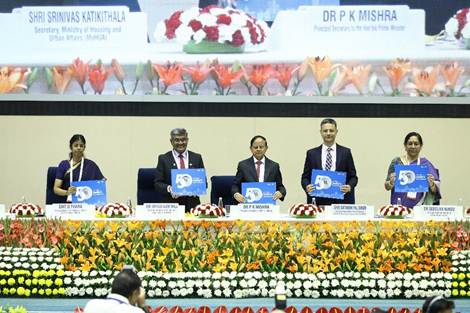
The National Urban Learning Platform was launched as the urban arm of iGOT-Mission Karmayogi, marking a new phase in technical capacity building for urban India through an integrated hybrid learning framework and four new technical courses.
The celebrations also included the convocation ceremony of the Urban Renaissance Tech Programme, recognising 127 students who completed the programme aimed at strengthening technology-led urban governance and innovation.
The celebrations featured nine technical deliberations on critical aspects of urban resilience and sustainable urban development. The session on ‘Urban Governance and Institutional Mechanisms Towards Resilient City Economic Region’ discussed ways to strengthen institutional capacity, improve coordination across levels of government, and advance integrated regional planning for resilient city economies.
The session on ‘Climate-responsive Urban Planning and Development’ examined how Indian cities can operationalise climate-responsive planning through better management of water and heat, urban form, building materials, codes and neighbourhood-level interventions in both existing and expanding urban areas.
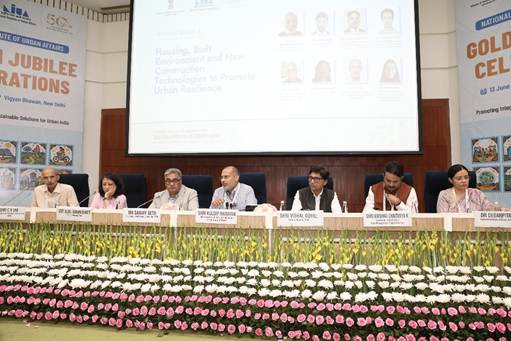
The session on ‘Housing, Built Environment and New Construction Technologies to Promote Urban Resilience’ focused on housing vulnerability and resilience through the lens of economic, social and climate risks, and discussed the role of new construction technologies in creating safer and more adaptive built environments.
The session on ‘Livelihoods and Urban Resilience’ discussed how the green transition, care economy and platform-based work can create pathways for informal workers to access more secure and stable livelihoods, while strengthening their economic resilience.
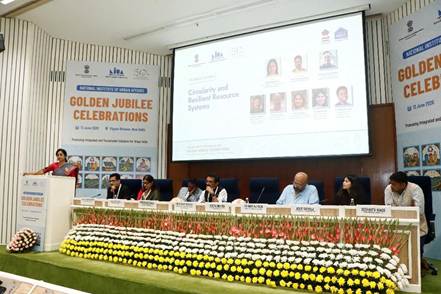
The session on ‘Circularity and Resilient Resource Systems’ examined the shift from conventional waste management to circular resource systems by strengthening segregation, recycling, reuse, value recovery and citizen participation across urban waste streams.
The session on ‘Urban Finance: PPPs, Infrastructure, Institutions and Climate’ discussed climate finance, public-private partnerships, blended finance, the Urban Challenge Fund, and the need to deepen the municipal bond market, including green bonds, to support urban local bodies.
The session on ‘Urban Mobility Systems: Towards Resilient Connectivity’ focused on integrated multimodal transport, sustainable mobility, transit-oriented development, first- and last-mile connectivity, intelligent transport systems, real-time data and climate-resilient transport infrastructure.
The session on ‘Industry, Research, Technology and Processes: Towards Urban Resilience’ discussed urban resilience as a multidimensional challenge and examined the role of industry, ESG principles, digital technologies and data-driven governance in supporting proactive urban management.
The session on ‘Building Team Urban: Strengthening Technical Capacities for Resilient and Progressive Urban India’ focused on future-ready skills, continuous learning systems, institutional capacity, leadership, accountability and improved service delivery across Urban Local Bodies.
The golden jubilee celebrations concluded with appreciation for NIUA’s five decades of service to India’s urban sector and its sustained contribution to research, policy support, capacity building, and implementation. As the Institute enters its next phase, the occasion reaffirmed confidence in NIUA’s continued role in supporting resilient, prosperous, inclusive and sustainable cities in the journey towards Viksit Bharat @2047.
********
SK
(Release ID: 2272513) Visitor Counter : 110