



PIB Backgrounder
Mumbai–Ahmedabad High-Speed Rail: Advancing India’s Rail Modernisation
Posted On: 12 JUN 2026 4:59PM by PIB Delhi
|
The Mumbai–Ahmedabad High-Speed Rail (MAHSR) Project represents a major milestone in India’s railway modernisation efforts. As the country’s first high-speed rail corridor, it seeks to transform inter-city mobility and strengthen domestic railway capabilities. The 508-kilometre corridor passes through Maharashtra, Gujarat, and Dadra & Nagar Haveli. It combines high-speed passenger transportation with extensive infrastructure development, including viaducts, tunnels, bridges, stations, and signalling and power systems. Beyond reducing travel time between Mumbai and Ahmedabad, the project is building technical expertise, industrial capacity, and institutional knowledge. These capabilities will support the future expansion of high-speed rail across India. |
From Conventional Rail to High-Speed Connectivity
Indian Railways is among the largest railway networks globally and remains a vital mode of passenger and freight transportation. By linking different regions, it facilitates the movement of people and goods across the country. This connectivity contributes to economic growth and improved access to markets, education, and essential services. To accommodate increasing transport requirements, the rail network and its carrying capacity have expanded steadily over the years.
India’s changing urban landscape has also transformed the way people live, work and travel. The development of major economic centres has increased the need for long-distance and inter-city travel. In response to these evolving mobility needs, India initiated the Mumbai–Ahmedabad High-Speed Rail (MAHSR) Corridor. With the foundation stone laid in September 2017, the project marked the beginning of India’s high-speed rail journey. The corridor aims to reduce travel time significantly while enhancing passenger comfort, safety, and reliability. It also represents a major step towards modernising India’s rail infrastructure and supporting sustainable economic development.
MAHSR: Transforming Vision into Infrastructure
High-Speed Rail (HSR) refers to passenger rail systems designed to operate at substantially higher speeds than conventional railways. These systems generally run on dedicated corridors and rely on advanced rolling stock, signalling, communication, and safety technologies. Such features enable high levels of operational efficiency and reliability. For operational purposes, high-speed rail is defined as railway systems operating at speeds exceeding 250 kilometres per hour.
Currently, the highest design speed in the Indian railway network is around 180 kmph, achieved by semi-high-speed services such as Vande Bharat. Against this, the Mumbai–Ahmedabad High Speed Rail (MAHSR) Project has a design speed of 350 kmph and an operational speed of 320 kmph. It is one of the most extensive rail infrastructure programmes undertaken in India, and will connect Mumbai and Ahmedabad in about 1 hour 58 minutes.
Besides providing high-speed passenger transport, this project will also establish for the first time, a domestic high-speed rail ecosystem. This ecosystem includes viaduct construction, ballastless track installation, tunnelling, bridge launching, and station-area planning. It also includes signalling and power systems, along with specialised training for Indian engineers and technicians. The knowledge, skills, and capabilities developed through the project are expected to support future high-speed rail corridors across the country.
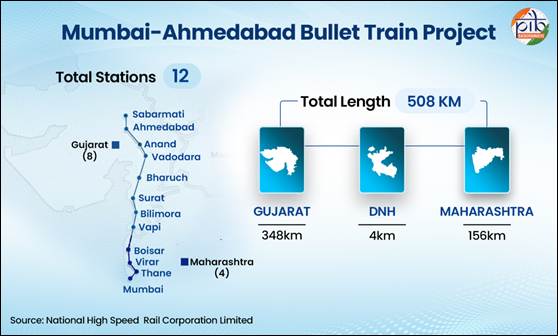
The 508-kilometre MAHSR corridor passes through Maharashtra, Gujarat, and Dadra & Nagar Haveli. The corridor comprises 12 stations at Mumbai (BKC), Thane, Virar, Boisar, Vapi, Bilimora, Surat, Bharuch, Vadodara, Anand, Ahmedabad, and Sabarmati. Each station is designed to reflect the character and spirit of its host city. Contemporary architecture, modern amenities, and multimodal connectivity are integral to their design. Sabarmati station is being developed as a multimodal hub linking the bullet train, metro, BRTS, and railway networks. The surrounding area is also being planned following transit-oriented development principles. The first high-speed rail service on the corridor is expected to commence in August 2027.
The route is about 90% elevated, with construction being carried out primarily through the Full Span Launching Method (FSLM). This technique is being used in India for the first time and is ten times faster than conventional segmental construction. Noise barriers are being installed on both sides of the viaduct to minimise operational noise. Together, these features highlight the corridor’s focus on efficient construction, operational performance, and integrated urban development.
Technical Features and Systems
The MAHSR Project is being developed using Japanese Shinkansen technology and operational standards. The corridor incorporates advanced systems for traction, electrification, track infrastructure, and operations. The official project overview records the following major technical components:
- Overhead Electrification (OHE): More than 20,000 OHE masts are planned along the corridor. The 2×25 kV overhead traction system uses Shinkansen-based OHE cantilevers.
- Traction and Power Supply: The project includes 12 traction substations, 2 depot traction substations, and 16 distribution substations.
- Track System: J-Slab ballastless track based on Japanese Shinkansen technology is being deployed for the first time in India.
- Track Construction Bases: Dedicated Track Construction Bases are being established for handling rails, track slabs, machinery, and equipment.
- Rolling Stock Depots: Three depots are under construction at Sabarmati and Surat in Gujarat, and Thane in Maharashtra.
Engineering Progress Across the Corridor
The MAHSR corridor traverses rivers, urban areas, and challenging terrain, requiring extensive bridge and tunnel infrastructure. These structures represent some of the most complex engineering components of the project.
Bridge Works Across the Corridor
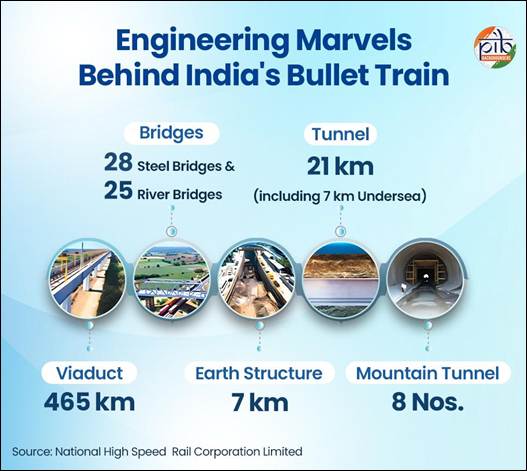
The corridor includes 25 river bridges, out of which 21 are located in Gujarat and 4 in Maharashtra. Bridge construction has been completed on several rivers, including the Meshwa, Vatrak, Mohar (Shedhi), Vishwamitri, Dhadhar, Kim, Mindhola, Purna, Ambika, Venganiya, Kaveri, Kharera, Auranga, Par, Kolak, Daman Ganga, and Darotha rivers.
- Work is advancing on major crossings over the Sabarmati, Narmada, Tapi, Jagani, and Vaitarna rivers.
- At the Mahi River bridge, 11 of the 12 wells have been completed, and five spans have been launched.
- At the Tapi River bridge, foundation works are underway, and 10 of the 12 wells have been completed.
- At the Sabarmati River bridge, substructure works have been completed and superstructure construction is underway.
- Geotechnical investigations have been completed for the Desai Khadi crossing, and design works are in progress.
- A Temporary Access Bridge has also been completed at the Ulhas River Branch crossing.
In addition to river crossings, the corridor includes 28 steel bridges over highways, canals, rivers, and railway tracks. Together, these structures form a critical component of the corridor’s engineering infrastructure.
India’s First Undersea Rail Tunnel
The corridor includes about a 21 km tunnel section in Maharashtra. This section features India’s first undersea rail tunnel beneath Thane Creek. The undersea stretch extends for approximately 7 km. Tunnel construction combines the New Austrian Tunnelling Method (NATM) and Tunnel Boring Machine (TBM) technology. The alignment comprises a 5 km NATM section and a 16 km TBM section. Both tracks will be accommodated within a single tunnel tube measuring 13.1 m in diameter. The TBM cutter head has a diameter of 13.6 m, the largest used in an Indian railway project. Construction has advanced steadily, with 4.8 km of the undersea tunnel between Ghansoli and Shilphata already completed.
|
Tunnel Boring Machines (TBMs) Used extensively in metro networks and long rail/road tunnels, TBMs provide high precision, reduced vibration, and enhanced safety in densely populated and geologically complex regions. New Austrian Tunnelling Method (NATM) Widely adopted in the mountain region, NATM allows engineers to adapt excavation support in real time, making it ideal for variable and fragile rock formations. |
Ensuring Safe and Reliable Operations
The MAHSR corridor incorporates advanced safety and monitoring systems to ensure reliable train operations under varying environmental conditions. These include earthquake detection, rainfall monitoring, and wind speed monitoring systems that enable real-time assessment and prompt operational response whenever required.
Rainfall Monitoring System
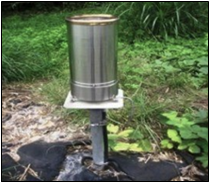
To ensure the safe operation of Bullet Train services, an automated Rainfall Monitoring System has been adopted. The system provides real-time rainfall data through instrumented rain gauges installed at critical locations along the corridor. Rainfall information is continuously transmitted to the Operation Control Centre (OCC), where it is monitored to support operational decision-making. Two key parameters are measured, namely, hourly rainfall and cumulative rainfall over the previous 24 hours. These measurements help assess conditions around earth structures, natural slopes, tunnel portals and other vulnerable locations. Based on predefined threshold values and field verification by maintenance teams, appropriate operational measures can be implemented whenever necessary. Six instrumented rain gauge stations are proposed along the Mumbai–Ahmedabad Bullet Train corridor. Each station will monitor an area with an approximate influence radius of 10 kilometres.
Wind Speed Monitoring System
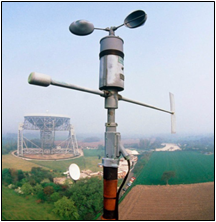
Parts of the MAHSR corridor pass through coastal regions and other locations that experience strong winds. To ensure safe train operations in such areas, a dedicated Wind Speed Monitoring System has been incorporated along the corridor. Fourteen locations, including 9 in Gujarat and 5 in Maharashtra have been identified for the installation of anemometers. These instruments provide real-time measurement of wind speed and direction and can record wind speeds ranging from 0 to 252 kmph. The data is continuously monitored at the Operation Control Centre (OCC). When wind speeds reach prescribed thresholds, operational protocols are activated. For wind speeds between 72 kmph and 130 kmph, train speeds will be regulated to ensure safe operations.
Early Earthquake Detection System
To enhance passenger safety, the MAHSR will be equipped with an Early Earthquake Detection System comprising 28 seismometers. The system will detect primary earthquake waves and automatically trigger a power shutdown. This enables trains in the affected section to stop safely through emergency braking. Of the 28 seismometers, 22 will be installed along the corridor alignment. The remaining 6 will be located in earthquake-prone areas identified through detailed seismic surveys and soil suitability studies. These locations were selected based on historical earthquake data and microtremor testing.
Major Project Milestones in 2026
A number of significant milestones have been recorded during 2026, marking progress across different components of the corridor. The following developments provide the project’s pace of implementation.
|
Date |
Milestone |
|
29 Jan 2026 |
100 m long ‘Make in India’ steel bridge completed in Ahmedabad. |
|
03 Feb 2026 |
Second mountain tunnel breakthrough achieved in Palghar, Maharashtra. |
|
17 Mar 2026 |
Bullet train stations set to integrate into the city’s transport ecosystem. |
|
08 Apr 2026 |
Heaviest portal beam launched over operational railway tracks. |
|
09 Apr 2026 |
Assembly of the first TBM began at Vikhroli, Maharashtra. |
|
11 Apr 2026 |
Assembly of the second TBM began at Sawli. |
|
22 Apr 2026 |
Track installation work on the bullet train viaduct. |
|
27 Apr 2026 |
Construction advances on the Sabarmati River bridge. |
|
04 May 2026 |
All five heavy portal beams launched over railway tracks in Amdavad within 22 days. |
|
17 May 2026 |
350-tonne cutterhead lowered at Vikhroli. |
|
20 May 2026 |
130 m long span of steel bridge launched near Bharuch. |
|
23 May 2026 |
Second TBM cutterhead lowered at Sawli near Mumbai. |
|
27 May 2026 |
45 m segmental bridge completed over Kalupur Flyover in Amdavad. |
|
02 Jun 2026 |
Third mountain tunnel breakthrough achieved in Palghar district. |
Driving Economic and Social Transformation
In addition to enhancing connectivity, the bullet train project is expected to generate employment, strengthen industries, support tourism, and advance domestic manufacturing.
Faster Connectivity
The MAHSR project will reduce travel time between Mumbai and Ahmedabad to under two hours. The same journey currently takes 8–9 hours by road and around 4–5 hours by air, including airport procedures. Faster travel can improve business efficiency and save valuable time for passengers.
Strengthening Regional Economies
High-speed rail will bring industrial centres and markets closer together. Improved connectivity between manufacturing hubs such as Vapi and Mumbai will strengthen supply chains and expand business opportunities across the corridor.
Tourism and Local Development
The corridor passes through regions known for natural, cultural and historical attractions. Better accessibility can support tourism, hospitality and related services. Stations are also expected to encourage commercial activity and local development.
Building Skills, Creating Opportunities
The project is expected to create around 4,000 direct jobs and 35,000–40,000 indirect jobs. Approximately 40,000 workers are expected to be engaged during construction. A dedicated High-Speed Rail Training Institute in Vadodara will help develop expertise in advanced rail technologies.
Supporting Make in India
The project supports the Make in India initiative through technology transfer and domestic manufacturing. Participation of Indian companies in project components is expected to strengthen industrial capabilities and support allied sectors such as steel, cement and electrical equipment.
High‑Speed Rail Corridors in Union Budget 2026–27
Taking forward the vision of a modern, high-speed rail network, the Union Budget 2026–27 announced seven high-speed rail corridors as growth connectors. These corridors will integrate key cities and regions, facilitate efficient movement of people, and support economic interaction across states. Spanning nearly 4,000 kilometres, the proposed corridors are expected to attract investments of approximately ₹16 lakh crore. These developments signal a shift towards high-speed rail as a key component of India’s transport infrastructure.
The planned high-speed rail corridors are strategically located across different regions of the country.
|
Routes |
Travel Time |
|
Delhi–Varanasi |
3 hours 50 minutes |
|
Varanasi–Patna–Siliguri |
2 hours 55 minutes |
|
Chennai–Bengaluru |
1 hour 13 minutes |
|
Bengaluru–Hyderabad |
2 hours |
|
Chennai–Hyderabad |
2 hours 55 minutes |
|
Mumbai–Pune |
48 minutes |
|
Pune–Hyderabad |
1 hour 55 minutes |
Shaping the Future of Rail Transportation
The Mumbai–Ahmedabad High-Speed Rail Project represents a transformative phase in India’s railway development. As the country’s first high-speed rail corridor, it is introducing new standards in speed, connectivity, and infrastructure delivery. Significant advancements in civil works, bridge construction, and tunnelling indicate steady momentum towards project completion. The scale of construction achieved so far demonstrates steady progress across multiple project components. At the same time, the adoption of advanced technologies and engineering practices is strengthening domestic capabilities in high-speed rail development. The MAHSR Project serves not only as a transportation initiative but also as a catalyst for India’s long-term high-speed rail ambitions.
References
Prime Minister’s Office
https://www.pib.gov.in/newsite/printrelease.aspx?relid=170771®=48&lang=2
Ministry of Railways
https://www.pib.gov.in/PressReleasePage.aspx?PRID=2257831®=1&lang=1
https://www.pib.gov.in/PressReleasePage.aspx?PRID=2267962®=48&lang=1
https://sansad.in/getFile/loksabhaquestions/annex/187/AS538_MhnJmI.pdf?source=pqals
https://www.pib.gov.in/PressReleasePage.aspx?PRID=2176788®=48&lang=2
https://www.pib.gov.in/PressReleasePage.aspx?PRID=2221838®=48&lang=2
National High-Speed Rail Corporation Limited
https://www.nhsrcl.in/en/project/project-overview
https://www.nhsrcl.in/en/media/press-release
https://www.nhsrcl.in/en/project/safety-features
****
PIB Research
(Release ID: 2272190) Visitor Counter : 183