


































Ministry of Agriculture &
Farmers Welfare
“Stubble is not a problem, but a solution for enhancing farmers’ income and improving soil health”: High-level inter-ministerial meeting held at Krishi Bhawan
Union Agriculture Minister Shri Shivraj Singh Chouhan sends a clear message to states: “Take action on a war footing to prevent stubble burning; very little time remains”
“We must protect the soil and ensure farmers’ prosperity”: Union Agriculture Minister Shri Shivraj Singh Chouhan
“Machines must operate in fields, not merely exist on paper: Repair old machines and ensure their availability to small farmers at subsidised rates”: Shri Shivraj Singh
“The Central Government is extending all possible financial assistance to states; Punjab must submit its Utilisation Certificate (UC) promptly to enable the next instalment to be released”: Shri Shivraj Singh Chouhan
“Collectors must take charge in the field and work through micro-planning: Prepare a roadmap to convert stubble into electricity, bio-CNG and manure instead of smoke”: Shri Shivraj Singh Chouhan
प्रविष्टि तिथि: 13 OCT 2026 8:43PM by PIB Delhi
A high-level inter-ministerial review meeting was held today at Krishi Bhawan, New Delhi, to implement crop residue (stubble) management in mission mode during the ongoing paddy harvesting season. The meeting was co-chaired by Union Minister for Agriculture and Farmers’ Welfare, and Rural Development Shri Shivraj Singh Chouhan, and Union Minister for Environment, Forest and Climate Change, Shri Bhupender Yadav. Union Minister of State for Agriculture and Farmers’ Welfare, Shri Bhagirath Choudhary, the agriculture ministers of key states, including Delhi-NCR, Punjab, Haryana, Uttar Pradesh and Madhya Pradesh, Union Agriculture Secretary Shri Atish Chandra, Union Secretary for Environment, Forest and Climate Change Shri Narendra Bhushan, and other senior officials from the Central and state governments were present at the meeting.
During the meeting, both Union Ministers made it clear that very little time remained between the completion of crop harvesting and the sowing of rabi crops. Therefore, the administrative machinery must move beyond files and take action directly on the ground on a war footing. They issued firm directions for district-level collectors to convene meetings promptly, strengthen monitoring and ensure that practical solutions were implemented without delay. The emphasis was on swift coordination and effective action at the field level to prevent stubble burning during the critical period.
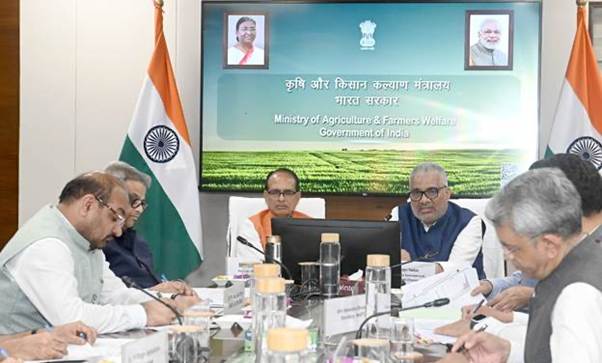
“Stubble is not a problem, but a means of improving farmers’ income and soil health”: Shri Shivraj Singh Chouhan
Addressing the meeting, Union Agriculture Minister Shri Shivraj Singh Chouhan said that paddy harvesting was underway and farmers were eager to prepare their fields for the next crop. In such circumstances, merely telling farmers not to burn stubble would not be enough. They must be provided with alternatives that are easy to use, readily accessible and affordable. Stubble burning not only causes air pollution but also destroys beneficial soil organisms and burns away essential nutrients, turning them into ash. It is therefore necessary to protect Mother Earth and preserve soil health. When crop residue is incorporated into the soil, it can be converted into organic manure; when removed from the field, it can serve as a source of additional income for farmers through its use in bio-CNG, bio-ethanol, electricity generation and animal fodder.
He further stated that the objective was not merely to prevent stubble fires but to develop a robust system in which farmers would have no need to burn crop residue in the first place. The aim should be to create practical and economically viable arrangements for managing stubble while enabling farmers to benefit from opportunities such as carbon credits through environmentally sustainable agricultural practices. Such an approach would protect the environment while also strengthening farmers’ livelihoods and improving the long-term sustainability of agriculture.
Concern over rising incidents in Madhya Pradesh and Rajasthan; directions issued for action on a war footing
Commenting on the analysis of the data presented during the meeting, Shri Shivraj Chouhan said it was encouraging that, between September 15 and October 12, stubble-burning incidents had declined significantly compared with the corresponding period last year. Haryana recorded a reduction of 53.3 per cent, while Uttar Pradesh registered a decline of approximately 32 per cent. Punjab had also recorded some reduction. However, expressing concern over the increase in stubble-burning incidents in Madhya Pradesh and Rajasthan, the Union Agriculture Minister directed both states to identify the affected districts and villages and immediately implement special action plans to address the situation. He emphasised that a substantial portion of harvesting was still pending. Therefore, even states that had achieved a reduction in incidents must not become complacent and should maintain complete vigilance throughout the remaining harvesting period.
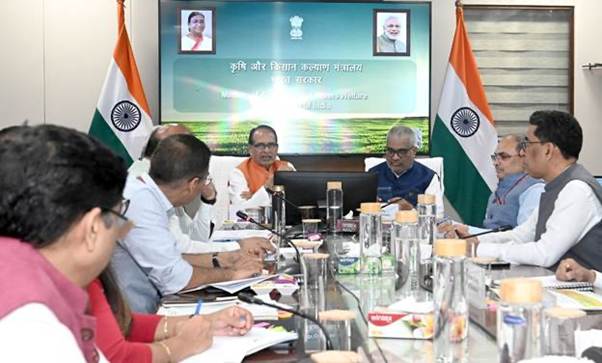
Ensure 100 per cent utilisation of machines; prevent older machines from remaining out of operation
Union Minister Shri Shivraj Chouhan placed particular emphasis on ensuring that crop residue management machinery remained operational and was put to effective use. He stated that the Central Government had so far provided states with more than 3.54 lakh crop residue management machines, including 26,109 new machines during the current financial year, 2026–27. He directed the authorities to ensure that, alongside the distribution of new machines, older machines that had become non-functional were repaired immediately and brought back into operation. Failure to do so could create an unnecessary shortage of equipment despite the machinery already available. He also stressed the need to activate Custom Hiring Centres (CHCs) and ensure that small and marginal farmers could access the required machinery at affordable, subsidised rates. The focus must be on making the equipment genuinely available to farmers when they need it, rather than allowing it to remain unused.
Substantial financial assistance from the Centre; Punjab urged to submit Utilisation Certificate promptly
Regarding the availability of funds, the meeting was informed that the Central Government had released a substantial amount of ₹4,266.47 crore to states under the Crop Residue Management (CRM) scheme between 2018–19 and 2025–26. This included ₹2,056.50 crore for Punjab, ₹1,171.71 crore for Haryana, ₹868.67 crore for Uttar Pradesh and ₹59 crore for Madhya Pradesh. For the current financial year, 2026–27, an allocation of ₹592.57 crore had also been earmarked, of which ₹430.87 crore had already been released. However, Union Minister Shri Shivraj Singh Chouhan expressed concern over the slow utilisation of the allocated funds. He stressed that farmers must receive the necessary resources and equipment in time for them to manage crop residue effectively. In particular, the Punjab Government was urged to submit the Utilisation Certificate (UC) for the funds released earlier to the Centre without delay. This would enable the next instalment under the scheme to be released promptly and without any disruption, ensuring the continued availability of financial support for crop residue management measures.
Use stubble as fodder in drought-affected areas; establish direct links between farmers and industries
Union Agriculture Minister Shri Shivraj Singh Chouhan directed that, in areas facing drought-like conditions, stubble should be collected and stored safely for use as animal fodder and subsequently supplied to livestock. He also called for farmers to be connected directly with supply chains serving thermal power plants for the co-firing of stubble pellets, compressed biogas (CBG) facilities and second-generation (2G) bio-ethanol plants. Such linkages would help create additional avenues for the productive utilisation of crop residue and provide farmers with opportunities to earn additional income. He asked state governments to ensure that approved supply projects were implemented on the ground without delay. He also stressed the need to encourage improved, short-duration paddy varieties, such as Pusa 2090 and PR126, in place of longer-duration varieties such as Pusa-44. Shorter-duration varieties would allow farmers to harvest their crops earlier and provide sufficient time to clear their fields before the next sowing season.
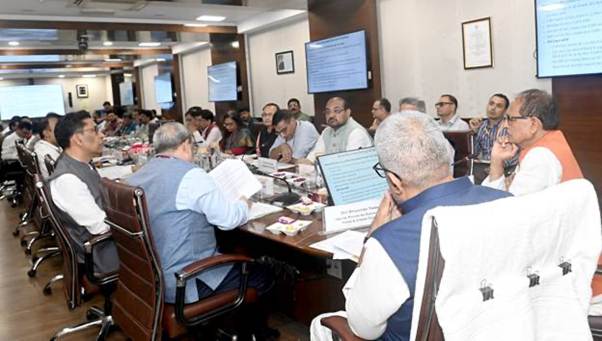
Assurance of all possible assistance to states
Union Minister Shri Shivraj Singh Chouhan said that the primary responsibility for implementation at the grassroots level rested with state governments. However, under the leadership and guidance of Prime Minister Shri Narendra Modi, the Central Government stood firmly alongside states and farmers, extending all possible technical, administrative and financial support at every stage. He called upon all participating ministries, Krishi Vigyan Kendras (KVKs) and district administrations to treat stubble management as a shared national commitment and work collectively towards its effective implementation. He emphasised that coordinated efforts by the Centre, state governments and local administrations were essential to ensure that practical solutions reached farmers in time. The ultimate objective was to keep agricultural fields free from pollution, protect soil health, improve farmers’ livelihoods and contribute to the prosperity of the farming community.
“Strict monitoring of the satellite observation gap after 3 PM directed”: Shri Bhupender Yadav
Union Minister for Environment, Forest and Climate Change Shri Bhupender Yadav stressed the need to intensify ground-level monitoring and enforcement measures to prevent stubble-burning incidents. He called for special vigilance in key districts of Punjab, including Sangrur, Tarn Taran, Amritsar, Patiala and Gurdaspur, as well as in Haryana districts such as Kaithal, Karnal, Kurukshetra, Ambala and Fatehabad. The objective was to assess crop-harvesting patterns in these areas and anticipate the likelihood of stubble-burning incidents so that preventive measures could be undertaken in advance. He emphasised the importance of identifying vulnerable areas and strengthening local monitoring arrangements during the ongoing harvesting season.
Shri Yadav highlighted the need to integrate data relating to stubble burning with the Commission for Air Quality Management (CAQM) and the Central Pollution Control Board (CPCB) to improve the effectiveness of monitoring. He said it was important to forecast the likely timing of harvesting in the coming days and closely monitor meteorological conditions that could affect air pollution levels in the National Capital Region (NCR). Such information would help authorities assess the evolving situation and take the necessary action in a timely manner. He also called for effective evaluation of the impact of interventions and the identification of corrective measures to address emerging challenges. Continuous assessment of the measures being implemented would be essential to strengthen the response and improve the effectiveness of efforts to prevent crop residue burning.
Emphasising that monitoring must not depend solely on satellite data, Shri Yadav said district collectors should undertake ground-level assessments and strengthen enforcement measures to make efforts to prevent crop residue burning more effective. He underlined the need for strict surveillance through ground patrols and flying squads during the gap in satellite monitoring after 3 PM, when no satellite pass is available. This period requires particular attention to ensure that incidents of stubble burning do not go undetected. He stressed that a combination of satellite-based monitoring, field inspections and effective enforcement would help authorities respond more promptly and prevent the burning of crop residue during the critical harvesting period.
*****
SS/DK/MK
(रिलीज़ आईडी: 2322991) आगंतुक पटल : 154