
The Lakhpati Didi Initiative
PIB Backgrounder
From Household Income Enhancement to Women-Led Rural Entrepreneurship
प्रविष्टि तिथि: 15 NOV 2026 12:07PM by PIB Delhi
The Lakhpati Didi Initiative promotes sustainable household incomes through women’s entrepreneurship and diversified livelihoods. It is being implemented under the DAY-NRLM, which leverages the SHG network to provide rural women with financial access, skills and market opportunities. The initiative’s implementation reflects a phased approach to policy planning, institutional strengthening and community mobilisation. As of June 2026, the initiative has enabled 3.76 crore Lakhpati Didis, with a target of six crore by March 2029.An independent assessment by IIM Ahmedabad reported a 61 percent rise in average monthly household income and a 61.7 percent increase in average monthly savings in Lakhpati Didi households.
From Subsistence to Sustainable Livelihoods
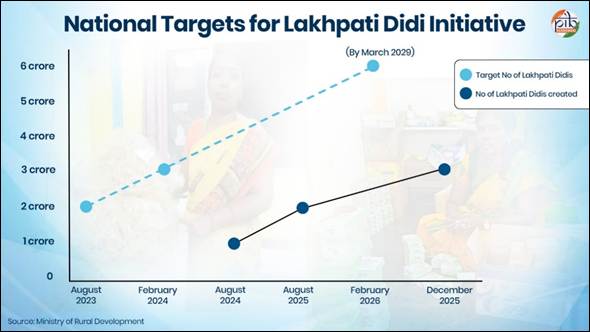
The Lakhpati Didi Initiative is a flagship effort to strengthen women’s economic participation in rural India. It aims to improve household incomes through sustainable livelihood opportunities and enterprise development. The government announced this initiative on 15 August 2023. It initially targeted two crore women from Self-Help Group (SHG) households. The target was subsequently increased to three crore in February 2024. The initiative aims to create six crore Lakhpati Didis by March 2029. This target was envisioned in February 2026.
A Lakhpati Didi is an SHG member whose household earns at least ₹1 lakh annually. The benchmark considers total household income rather than individual earnings. Income from eligible farm and non-farm activities contributes towards this target. It is calculated after expenses and should remain sustainable across agricultural seasons or business cycles.
The initiative builds on the institutional network of the Deendayal Antyodaya Yojana-National Rural Livelihoods Mission (DAY-NRLM). It seeks to move rural women beyond subsistence-based activities. Its approach combines livelihood diversification, financial inclusion, skill development and enterprise support.
3.76 Crore Rural SHG Women Enabled as Lakhpati Didis
By June 2026, 3.76 crore rural SHG women had been enabled as Lakhpati Didis and 5.70 crore women were identified as Potential Lakhpati Didis.
An independent evaluation of the Lakhpati Didi initiative by IIM Ahmedabad, covering 6,531 respondents in 17 states and UTs, reported improvements in household economic conditions. Average monthly household income increased by 61 percent, while average monthly savings increased by 61.7 percent.
Institutional Foundation: DAY-NRLM and the SHG Network
The Lakhpati Didi Initiative operates through DAY-NRLM. The government launched DAY-NRLM in June 2011. It organises women from poor rural households into SHGs. These groups promote regular savings and collective financial activities. They also connect members with banks, credit, training and markets. As of 12 November 2026, DAY-NRLM had mobilised approximately 10.13 crore SHG members into 94.40 lakh SHGs. SHGs function through a wider institutional structure. Village Organisations and Cluster Level Federations strengthen this network. This institutional foundation provided the delivery mechanism for the Lakhpati Didi Initiative. It enabled the government to build upon existing community institutions rather than establish a separate structure.
Evolution and Expansion of the Initiative
The initiative evolved through a series of policy decisions and implementation measures. In 2021, the government advised States to promote sustainable livelihoods and diversify farm and non-farm activities among SHG households. In August 2023, the government announced the target of enabling two crore rural SHG women as Lakhpati Didis. Recognising the need to strengthen community institutions for achieving this goal, the government conducted structured training for community cadres between November 2023 and March 2024. Approximately 5.5 lakh persons received training, which comprised of 12 modules delivered over 15 hours.
In February 2024, the Interim Budget increased the national target to three crore Lakhpati Didis. The Lakhpati Didi portal was also launched during this period. In May 2024, the Digital Aajeevika Register began recording the livelihoods and income of each household. Under this process, women are identified as ‘Potential Lakhpati Didis’ on the LokOS platform. Trained Community Resource Persons (CRPs) prepare business plans for individual households. Households then receive coordinated support in areas such as skills, finance, assets and markets. The national and state missions monitor progress through the same register. By August 2024, one crore women had achieved Lakhpati Didi status.
Further digital interventions followed in July 2025, with the introduction of the Didi Business Plan tool and a financial-literacy application for CRPs. The reported achievement in creating Lakhpati Didis increased to two crore women in August 2025. By December 2025, the initiative had achieved its three-crore target ahead of schedule. Subsequently, in February 2026, the government revised the national target to six crore Lakhpati Didis by March 2029.
Identification and Implementation Framework
The initiative follows a community-led identification and implementation process. It provides equal opportunities to SHG members across social and economic categories. Potential Lakhpati Didis are identified through consultations. Trained Community Resource Persons (CRPs) facilitate this process. They assess household livelihoods and support women in identifying additional income opportunities. The implementation framework follows several stages:
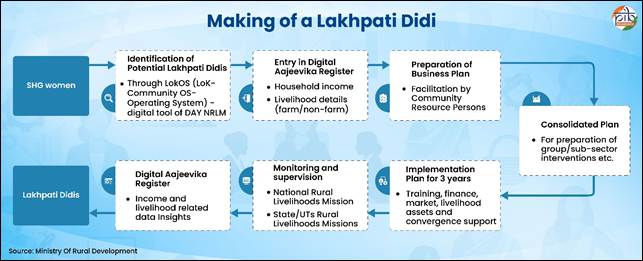
- Identification: Potential beneficiaries are identified through the SHG network and LokOS platform.
- Income Assessment: Household livelihoods, income and expenditure details are recorded. The Digital Aajeevika Register provides a common monitoring framework.
- Enterprise Planning: CRPs prepare individual business plans. These plans are consolidated to identify common requirements and sectoral opportunities.
- Implementation Support: Women receive coordinated assistance over three years. This includes training, finance, livelihood assets and market access.
- Monitoring: National and State missions review progress through digital records. State missions also validate reported achievements.
This process connects household-level planning with institutional support. It also allows interventions to respond to local livelihood requirements.
Leadership in Action: From Strategic Planning to Implementation
The initiative’s implementation reflects a phased approach to policy planning, institutional strengthening and community mobilisation.
- The groundwork began on21October 2021, when the government issued an advisory to States. It encouraged sustainable diversified farm and non-farm livelihoods among SHG households under DAY-NRLM. On 29 December 2021, the government requested States to establish time-bound targets.
- Subsequently, a communication dated 10 June 2022 introduced a mobile application-based household income survey to provide an evidence base for identifying household income gaps and planning targeted interventions.
- On 6 September 2023, the government organised a National Conclave, in which State missions, development partners and line ministries participated. The government released a Strategy Note on Enabling Two Crore Lakhpati SHG Didis. The strategy adopted an institutional approach by leveraging the existing DAY-NRLM network. The design recognised four critical considerations. Additional credit needed to support viable livelihoods and repayment capacity. Household income required a consistent measurement framework. State capacities varied and required context-specific support. Community institutions also needed adequate training to prepare household-level plans. These considerations were presented to the Prime Minister on 10 October 2023. The Ministry of Rural Development subsequently submitted a detailed action plan to the Prime Minister’s Office. It issued implementation action points on 16 October 2023.
- Consultations with States also identified 12 priority livelihood sub-sectors. These included bamboo, honey, goat rearing, poultry and tasar silk.
- During 2024, the initiative received continued leadership attention through national addresses and direct interactions. The Prime Minister referred to it during Mann Ki Baat and other national addresses. He also interacted with SHG women, drone operators and entrepreneurs. A Performance Review Committee meeting took place in July 2024. The government also organised regional consultations across Guwahati, Srinagar, Jaipur, Hyderabad, Bengaluru and Raipur during 2024-25. These engagements facilitated interaction with State missions and enabled discussions on implementation progress.
- In January 2025, a Lakhpati Didi tableau featured in the Republic Day parade on Kartavya Path. The government conducted refresher training during February-March 2025. In March2025, it initiated discussions with the Agriculture, Animal Husbandry and MSME departments. These discussions focused on convergence between their respective schemes. The government also introduced a learning portal and chatbot in October 2025.
- The government also strengthened data governance during 2025-26. It introduced checks to identify unusual income entries. State missions were asked to reconcile discrepancies and certify reported figures. This helped strengthen the credibility of progress assessments. In 2026, implementation support expanded further through digital and institutional interventions. An application for individual enterprise loans was introduced on 21 February 2026. An upgraded version of LokOS followed in May 2026. Regional workshops were organised at Gaya and Pushkar. A review involving all States took place during the Rashtriya Grameen Vikas Sammelan on 28-29 June 2026. On 29 June 2026, a platform for producer groups and enterprises and a public Lakhpati Didi dashboard were also launched.
Overall, the implementation approach demonstrates the importance of leadership beyond target-setting. The government combined evidence-based planning with institutional capacity building. It leveraged existing community networks and promoted interdepartmental convergence. Regular reviews, digital tools and data validation strengthened monitoring and accountability. This combination enabled a nationally coordinated initiative to function through decentralised, community-led institutions.
Building Women-Led Rural Prosperity
The Lakhpati Didi Initiative represents an approach to rural livelihood development centred on women. It combines existing community institutions with enterprise planning and financial support. Its focus extends beyond increasing household income. It also promotes diversified livelihoods, entrepreneurship and community leadership. By enabling women to become active economic contributors, the initiative seeks to strengthen rural households. It also creates pathways for broader rural economic development.
References
Ministry of Rural Development
https://lakhpatididi.gov.in/insight-hub/
PIB Backgrounders
https://static.pib.gov.in/WriteReadData/specificdocs/documents/2024/aug/doc2024829382701.pdf
***
PIB Research
(रिलीज़ आईडी: 2336452) आगंतुक पटल : 30