






























Ministry of Social Justice & Empowerment
18,093 villages declared Adarsh Grams; Approximately Rs 1,730 Crore released under Grant In Aid directly to States And Districts
785 student hostels completed; Rs 61.46 Crore Allocated For FY 2026-27 for two hostel projects Accommodating 264 Boys/ Girls Students
प्रविष्टि तिथि: 16 OCT 2026 6:26PM by PIB Delhi
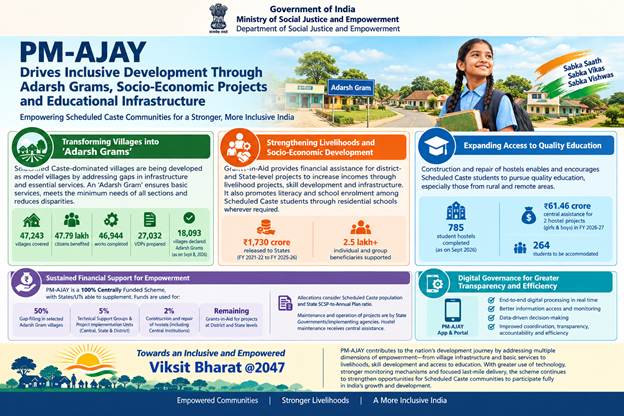
Under the Adarsh Gram component of Pradhan Mantri Anusuchit Jaati Abhyuday Yojana (PM-AJAY) implemented by the Ministry of Social Justice and Empowerment, over 47,200 villages benefiting more than 47.79 lakh citizens across the country, have been covered. In addition, a total of 46,944 development works have been completed, while 27,032 Village Development Plans (VDPs) have been prepared, under the PM AJAY.
A Senior Official in the Ministry said as on September 8, 2026, 18,093 villages had been declared Adarsh Grams which reflects continued efforts of the Ministry to improve infrastructure, basic services and the quality of life in Scheduled Caste-majority villages.
He said the Scheduled Caste-dominated villages are being developed as model villages by addressing critical gaps in infrastructure and essential services and an ‘Adarsh Gram’ is envisioned as a village where people have access to basic services, the minimum needs of all sections of society are met and disparities are reduced to a minimum.
The Pradhan Mantri Anusuchit Jaati Abhyuday Yojana (PM-AJAY) implemented by the Ministry, is advancing the socio-economic and educational empowerment of Scheduled Caste communities through infrastructure development, livelihood promotion, education and improved access to basic services.
The Official informed that the Scheme has three components including development of Scheduled Caste-dominated villages into ‘Adarsh Grams’, Grants-in-Aid for socio-economic projects at the State and District levels, and construction and repair of hostels.
He stated that the Grants-in-Aid component provides financial assistance for district and State-level projects aimed at the socio-economic advancement of Scheduled Castes. It focuses on increasing the income of the target population through comprehensive livelihood projects, skill development and related infrastructure, he added.
He said it also seeks to improve socio-economic development indicators by creating adequate infrastructure in Scheduled Caste-dominated villages and to promote literacy and school enrolment among Scheduled Caste students through residential schools wherever required.
The Official said an approximately Rs 1,730 Crore was released directly to States under this component during FY 2021-22 to FY 2025-26. The support has extended skilling and livelihood opportunities to more than 2.5 lakh individual and group beneficiaries, he added.
The Official further said under the PM-AJAY’s component of construction and repair of hostels, the Ministry pursues enabling and encouraging Scheduled Caste students to pursue quality education as these hostels are particularly beneficial for students from rural and remote areas by providing access to accommodation and educational opportunities.
He said as of September 2026, a total of 785 student hostels had been completed under the scheme. For FY 2026-27, the Government has allocated Rs 61.46 crore in central assistance for two hostel projects—one for girls and one for boys—which will provide accommodation for 264 students, he further said.
The Ministry Official further said a major step towards strengthening implementation and monitoring has been the launch of the PM-AJAY Mobile App and PM-AJAY Portal, facilitating a transition from paper-based workflows to end-to-end digital processing on a real-time basis.
He said technology-enabled governance is strengthening information access, monitoring and data-driven decision-making under the scheme while as the digital framework is also aimed at improving coordination, transparency, accountability and efficiency in the delivery of welfare interventions.
The Official further stated that PM-AJAY is a 100 per cent Centrally Funded Scheme, while States and Union Territories may supplement it with additional resources wherever required. Under the funding framework, up to 50 per cent of funds may be utilised for gap-filling activities in selected Adarsh Gram villages. Up to 5 per cent is allocated for setting up and operating Technical Support Groups and Project Implementation Units at the Central, State and District levels. Up to 2 per cent is earmarked for construction and repair of hostels, including support for Central Institutions, while the remaining funds are provided as Grants-in-Aid for projects at the District and State levels.
Grants-in-Aid allocations take into account factors including the Scheduled Caste population and the ratio of State SCSP to the Annual Plan in relation to the Scheduled Caste population of States and Union Territories. Following completion of infrastructure projects, their maintenance and operation are to be undertaken by the concerned State Governments or implementing agencies. Under the hostel component, the Government of India also provides central assistance for maintenance.
As India progresses towards Viksit Bharat @2047, ensuring that the benefits of development reach every section of society remains central to the nation’s development journey.
PM-AJAY contributes to this objective by addressing multiple dimensions of empowerment—from village infrastructure and basic services to livelihoods, skill development and access to education.
With greater use of technology, stronger monitoring mechanisms and focused last-mile delivery, the scheme continues to strengthen opportunities for Scheduled Caste communities to participate more fully in India’s growth and development. Its integrated approach is helping create the infrastructure, capabilities and enabling environment required for individuals and communities to realise their full potential.
****
PR-169-TAR-KV-GA-RK
(रिलीज़ आईडी: 2324472) आगंतुक पटल : 167