

























Ministry of Rural Development
From Self-Help Group (SHGs) to enterprise, at the First National SARAS Mela outside Delhi-NCR
प्रविष्टि तिथि: 26 OCT 2026 3:40PM by PIB Delhi
Organised as an initiative of the Ministry of Rural Development, Government of India, in collaboration with the Government of Andhra Pradesh, with support from NABARD, NIRDPR and Kudumbashree, National SARAS Mela provides a platform to experience traditional crafts, entrepreneurship and the transformative journeys of women towards financial independence.
Behind every stall at Punnami Ghat is a woman who has believed in her skills, her craft, and herself to live the lakhpati didi dream. Over the days of the Mela, some women from SHGs share what it has felt like to turn a family craft or a first idea into an enterprise. The responsibility of taking charge, the cities that welcomed their work, and the confidence that grew with every step. Some of their annual turnover runs from ₹60 lakh to ₹1 crore.
Walk along the stalls at Punnami Ghat and every counter has a woman behind it, and a story that began far from Vijayawada.
A Lakhpati Didi is a woman from an SHG household with a sustainable annual household income of at least ₹1 lakh, the milestone at the centre of the Hon’ble Prime Minister Shri Narendra Modi’s vision of six crore Lakhpati Didis by 2029. Under the Deendayal Antyodaya Yojana-National Rural Livelihoods Mission (DAY-NRLM), skills, finance and market access help women build that income. These journeys show what can lie beyond the milestone.
The Lakhpati Didi Experience: Tales of Transformation
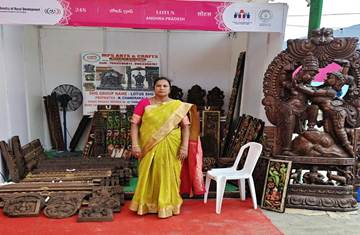
Chandrakala, Lotus SHG, Tirupati, Andhra Pradesh: The Craft She Carried Forward
The woodcarving workshop in Chandrakala’s family began in 2002, in a household that came from farming. Five years later, in 2007, her husband passed away, and the workshop became hers to run. The early months were about keeping orders moving and keeping the carvers’ trust. The craft was all around her. The customers, the accounts and the decisions were new.
Lotus SHG gave her women who understood what she was carrying, and a place to think aloud. Then the work began to travel. Exhibitions and trade fairs took her to Chennai, Mumbai, Vijayawada, Visakhapatnam and Delhi. For a woman from a farming family, every city was a first: a new station, a new stall, a customer who picked up a carving, turned it over in both hands and asked what it cost. She remembers the fair where her stock ran out before the day ended. Today the enterprise reports annual turnover of over ₹1 crore and paying GST of approximately 10 lacs per month and providing employment to 100 + members She is supplying her products through Lepakshi emporium showroom to many other cities. Her products are also being procured from her for gifting to ministers and celebrities.
What she wants next is larger than the number. “I want to take this business forward and create work for 500 rural women. That is how I hope to carry this legacy ahead.”
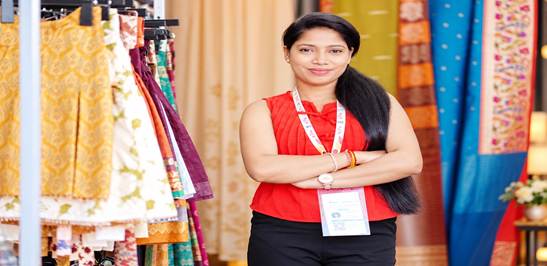
Siddhi, Mahamaya SHG, North Goa: Building a Business Through Social Media
Four years ago, after completing a diploma in Fashion designing, Siddhi began building an ethnic wear business through Instagram, starting on her own. She funded the venture herself. Already active on social media, she saw an opportunity to open a page for her work and reach customers. Mahamaya SHG helped her connect with women who could work with her and guided her on where to seek loans. She describes the relationship as one of mutual support. The group also keeps her informed about workshops on craft skills and marketing, which she and her team attend.
Today she runs a boutique of her own with a team of approximately seven to ten people, including women she has trained herself. She also steps in to do the cutting when needed. Their work includes tailoring, stitching, sourcing materials, packing and helping at exhibitions. She manages marketing through social media and her website blissbysiddhi.in , and sends orders received through Instagram to customers overseas through India Post, including Singapore, the UAE and the USA and many more countries. Her business reports annual turnover of ₹60 lakh.
At first, those around her were not very supportive of the idea and wanted her to take a regular job, preferably with the government. Siddhi chose to go ahead with the business. “I wish to help more and more ladies come join my team ,” she says. Over the next few years, she hopes to create work for around 100 more women across Goa and help them become financially independent.
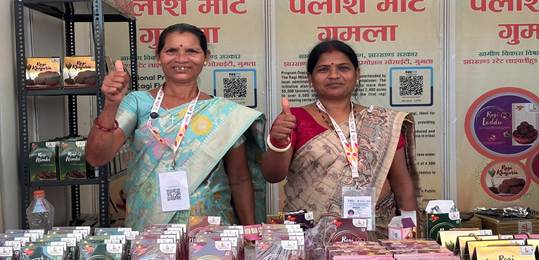
Kunwari Barwa, Mahila Vikas Mandal Baghima Palkot FPO, Gumla, Jharkhand: Building a Ragi Enterprise with Women Farmers
Kunwari Barwa’s journey began with a self-help group in her village, where women started by saving ₹2 each. She encouraged other women to join and took a loan from the pooled savings to buy a cow. Later, bank-linked credit helped her purchase equipment for vegetable cultivation. Growing and selling her produce gave her a way to support her family and pay for her children’s education.
As the groups came together, their work grew. In 2022, they formed a farmer producer organisation (FPO) with 381 members. Kunwari says its membership has since grown to 1,501. The collective helps farmers cultivate ragi, collects and stores the harvest, and makes ragi laddoos, thekua and savoury snacks. From small tables in Gumla, their products have reached fairs in Delhi, Hyderabad and other cities. She puts the collective’s monthly product sales at around ₹6–7 lakh.
The enterprise provides regular work for over 150 women and brings in more workers when orders increase. Fairs have also given the women opportunities to travel. “Some of our women had never even seen a railway line. Now we travel by train and even by plane,” she says.
Singampalli Parwathi W/0 RamiNaidu, Sri Durga Bhavani Farmer Producer Group, Anakapalli (D), Andhra Pradesh: A Small Beginning, a Business of Her Own
In Natavaram village in Andhra Pradesh’s Anakapalli district, Singampalli Parwathi’s family relied on a small farm, two dairy buffaloes and her husband’s daily-wage earnings to make ends meet. While these sources provided some income, they were often insufficient to meet household expenses and unexpected financial needs. In times of difficulty, the family had little choice but to borrow money at high interest rates, adding to their financial burden. Despite these challenges, Parwathi was determined to improve her family’s financial situation by starting a business of her own. However, limited access to capital remained a major obstacle to turning her ambition into reality.
A turning point came in 2018, when Parwathi joined the Sri Durga Bhavani Farmer Producer Group. Through the group, she accessed a loan of ₹20,000, which enabled her to begin buying and selling raw cashew nuts. This initial venture gave her an opportunity to understand the market, build business experience and take her first steps towards becoming an entrepreneur. Encouraged by the potential of the trade, she sought to expand her operations the following year. With a further loan of ₹50,000, she purchased two cutting machines and began processing cashew nuts to extract kernels, which she sold to traders in Tuni. By moving from trading raw cashews to processing them, she took an important step towards adding value to her products and increasing her business potential.
As her enterprise grew, Parwathi recognised the need for greater processing capacity to meet market demand and expand her reach. Financial support from the farmer producer group continued to play an important role in her journey. A loan of ₹2 lakh from the group, combined with ₹3 lakh in bank financing under the Prime Minister’s Employment Generation Programme (PMEGP), helped her establish a larger cashew-processing unit. This investment enabled her to strengthen her operations and develop her business beyond its modest beginnings.
Today, Parwathi processes cashews into 11 different grades, catering to varied customer requirements. She supplies her products to customers across the country and participates in exhibitions to showcase and sell her products, creating opportunities to reach new markets. Her enterprise has grown into a business with an annual turnover of approximately ₹50 lakh—a significant achievement from the small-scale venture she started with an initial loan of ₹20,000.
Parwathi’s journey demonstrates how access to timely credit, collective support and entrepreneurial determination can help rural women build sustainable livelihoods. What began as an effort to supplement her family’s income has evolved into a growing processing enterprise. The business that once seemed difficult to finance now contributes significantly to her family’s financial well-being, reflecting the potential of rural entrepreneurship to create economic opportunities and strengthen household livelihoods.

Behind each of these journeys is a shared pattern: a skill, a group of women who believed in it, and a market that came into view one fair or one order at a time. At the Lakhpati Didi Pavilion, visitors can hear directly from women on this path as they move from skills and collective participation towards enterprise, market access and sustainable income.
Beneath the 16-foot installation “SHAKTI – The Spirit of Lakhpati Didi”, these four women are among the many whose journeys it stands for.
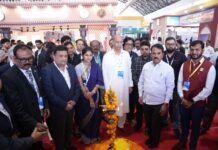
In her address at the inauguration, the Hon’ble President of India, Smt. Droupadi Murmu, encouraged women to build and grow their enterprises further, beyond the Lakhpati milestone. She also pointed to women’s control over their income and assets as a measure of empowerment, alongside their participation in economic activity. She noted that SARAS Melas would be organised every year in different states, giving rural women more opportunities to showcase and sell their products, reach new customers directly and strengthen their financial independence.
The First National SARAS Mela continues till 31 October 2026 at Punnami Ghat, Vijayawada, open daily from 11:00 am to 9:30 pm.
***
PU
(रिलीज़ आईडी: 2328458) आगंतुक पटल : 165