































Ministry of Personnel, Public Grievances & Pensions
Official Hindi Should Be Simple, Easy to Understand and Closer to Everyday Usage: Union Minister
Technology and AI Have Significantly Improved the Quality of Hindi Translation in Government Work: Dr. Jitendra Singh
Hindi Usage Has Increased Significantly Over the Last 10–12 Years after PM Sh Narendra Modi took over; Southern Officers Also Using Hindi Extensively: Dr. Jitendra Singh
DoPT Will Seriously Consider Suggestions of Hindi Advisory Committee and Refer Matters Beyond Its Mandate to Concerned Ministries
प्रविष्टि तिथि: 07 OCT 2026 3:18PM by PIB Delhi
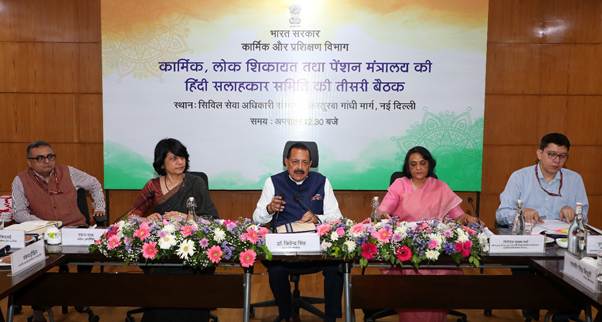
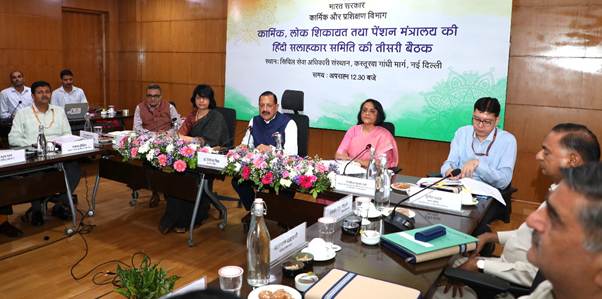
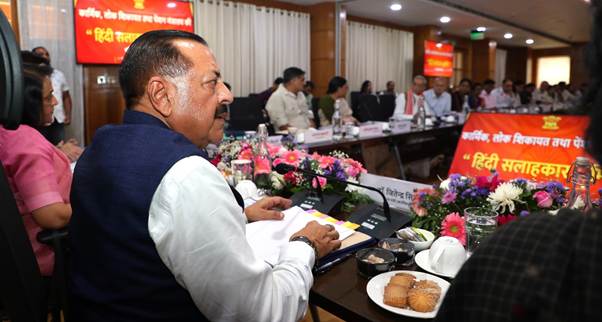
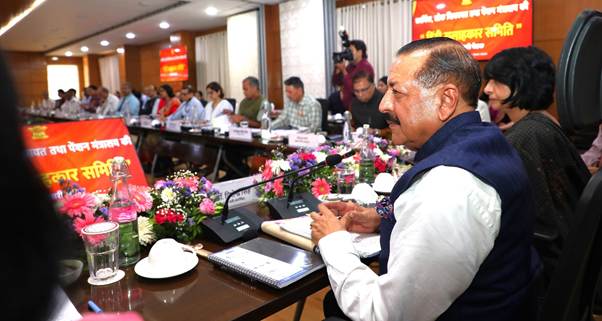
Union Minister of State (Independent Charge) for Science & Technology, Earth Sciences and MoS PMO, Personnel, Public Grievances, Pensions, Atomic Energy and Space, Dr. Jitendra Singh today emphasised that promotion of Hindi should be based on creating greater opportunities and stake in the language rather than making its use appear imposed. Addressing the third meeting of the Hindi Advisory Committee of the Ministry of Personnel, Public Grievances and Pensions, he said greater use of Hindi would naturally follow when knowledge of the language creates opportunities for employment and professional growth. The Kaushal Patrika of the Department of Personnel and Training (DoPT) was also launched on the occasion.
Dr. Jitendra Singh said the suggestions received from members of the Hindi Advisory Committee had been noted and that the Department would make serious efforts towards their implementation. He said suggestions falling outside the jurisdiction of the Department would be forwarded to the concerned Ministries and Departments so that they could be examined at the appropriate level.
Referring to a suggestion regarding language options in competitions conducted by the Ministry of Skill Development, the Minister said that such options could help make these initiatives more accessible to beneficiaries from smaller towns, cities and rural areas. He suggested that language options, including suitable oral components where appropriate, could make such initiatives more accessible, and said the suggestion could be conveyed to the Ministry concerned.
Dr. Jitendra Singh also referred to the suggestion of involving Hindi Advisory Committee members in programmes for teaching Hindi in schools. He said such proposals could be taken up with the Ministry of Education, particularly where programmes involve teachers and educational institutions, as the Personnel Department by itself may not be in a position to undertake such activities.
The Minister stressed that while a substantial amount of work in the Department is already carried out in Hindi, it may not always be practical to insist on 100 per cent use of Hindi, particularly in official communication with non-Hindi-speaking States. He said the sensitivities and convenience of people and officials in different linguistic regions have to be kept in mind.
Emphasising the need for simple and accessible official Hindi, Dr. Jitendra Singh said that government communication should not use unnecessarily difficult or highly formal Hindi. He said language used in official work should be such that it can be easily understood in everyday communication, rather than appearing like a literal translation from English.
The Minister said there has been a significant change in the use of Hindi during the last 10–12 years after PM Shri Narendra Modi took over, including increased use of the language by officers from southern parts of the country. He cited examples of officers and personnel in scientific and technical establishments using Hindi extensively in their official work despite being based in predominantly non-Hindi-speaking regions.
Dr. Jitendra Singh also highlighted improvements in the quality of translation in government work. Referring to the earlier occurrence of incorrect and sometimes misleading translations, he said such problems have reduced considerably. He noted that technology and AI-driven systems, along with the availability of larger datasets, are now contributing to improvements in translation, including in technically sensitive areas.
The Minister, however, cautioned against viewing Hindi usage in isolation from the wider requirement of knowledge and professional competence. He said that insisting exclusively on Hindi, particularly in specialised fields where adequate literature and terminology may not be readily available, should not become a barrier to knowledge acquisition. He referred to the experience of introducing Hindi in medical education and stressed that original technical terms can continue to be retained where necessary, while explanations and teaching can be provided in Hindi.
Dr. Jitendra Singh reiterated that creating a stake in a language is more effective for its promotion than merely imposing its use. He said that as Hindi becomes increasingly useful for employment and professional opportunities, people would have a natural incentive to learn and use it. He referred to the growing demand for Hindi learning even in regions where it was traditionally less prevalent, linking such interest to emerging employment opportunities.
The Minister said the Hindi Advisory Committee has an important role in providing informed suggestions and guidance to the Department. He invited members to continue sharing their ideas and suggestions in writing or through other appropriate means, adding that the Department would continue to work towards improvements based on their guidance.
Dr. Jitendra Singh said the larger objective should be to promote Hindi in a manner that is simple, natural and inclusive, so that its use does not create a sense of imposition. He emphasised that the ultimate goal is to expand the use and reach of Hindi while ensuring that it remains aligned with the country’s linguistic diversity and everyday communication needs.
The meeting also provided an opportunity for members of the Hindi Advisory Committee to place their suggestions before the Department on matters relating to the promotion and wider use of Hindi in official work.
****
NKR/AK
(रिलीज़ आईडी: 2320092) आगंतुक पटल : 76