


































Ministry of Environment, Forest and Climate Change
प्रविष्टि तिथि: 10 OCT 2026 6:41PM by PIB Delhi
A high-level team of Commission for Air Quality Management in NCR and Adjoining Areas (CAQM), under the chairmanship of Dr. S.D. Attri, Member (Technical), CAQM, visited Amritsar and Tarn Taran Districts of Punjab, during the ongoing paddy harvesting season. These districts have been identified as hotspots for paddy stubble burning. Apart from field visits, the visiting team held a review meeting in Amritsar today (10.10.2026) with Deputy Commissioners (DCs) and other district-level officials of Amritsar and Tarn Taran district. This visit, apart from deployment of Flying Squads, is in line with high priority attached by the Commission towards achieving the objective of reduction and elimination of paddy stubble burning, a major cause of winter air pollution in NCR and adjoining areas.
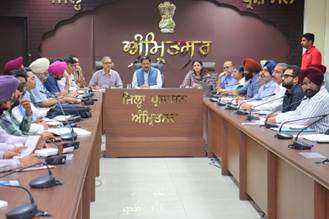
The deliberations focused on reviewing preparedness and coordination among the concerned departments and district administration for effective in-situ and ex-situ utilisation of paddy stubble. The Commission stressed upon the importance of facilitating the farmers in terms of timely availability of CRM Machines, sensitizing, conducting Information, Education and Communication (IEC) Activities and providing necessary support.
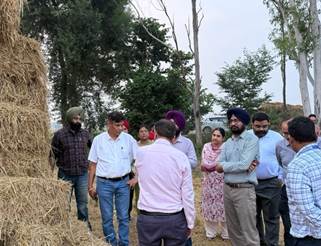
Along with the review meeting, CAQM undertook field visits on 09.10.2026 and 10.10.2026 to the selected hotspot villages and facilities in districts of Amritsar and Tarn Taran to assess the prevailing ground-level situation and review the implementation of measures aimed at preventing stubble burning.
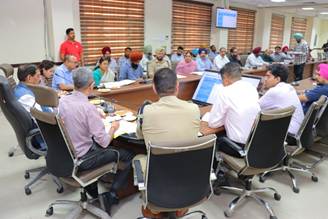
Regarding the district of Amritsar, the deliberations during the review meeting and field visit included the harvesting and procurement status, along with the availability and deployment of Crop Residue Management (CRM) machinery. It was informed that balers from Amritsar and adjoining districts were operating for collection and management of paddy straw. A supply chain has been established with industries having boilers for utilisation of paddy straw bales, with farmers and aggregators linked to these industries to facilitate ex-situ management. The district has also established a Control Room and Help Desk at the District Administrative Complex to identify farmers requiring CRM machinery and facilitate its availability. A district-level helpline has been circulated for reporting fire and stubble burning incidents to enable prompt action.
Regarding the district of Tarn Taran, the deliberations during the review meeting and field visit included the harvesting and procurement status and the availability and deployment of CRM machinery in the district. It was informed that balers from Tarn Taran and adjoining districts were operating for effective ex-situ management of paddy straw and that the district had substantially achieved its targets regarding procurement and availability of CRM machinery for farmers. Extensive field patrolling and surveillance through Nodal/ Cluster Officers and other field functionaries, along with IEC Activsties and enforcement measures to promote in-situ and ex-situ utilistion of paddy straw were also highlighted.
The officers of both districts assured their utmost commitment towards implementation of the CAQM’S Statutory Direction(s), strengthening preventive measures and making concerted efforts to ensure effective prevention of stubble burning incidents in their respective districts.
Additionally, as part of the monitoring mechanism, Flying Squads deputed by the Commission have been deployed in 18 districts across Punjab, namely Sangrur, Tarn Taran, Firozpur, Muktsar, Bathinda, Amritsar, Moga, Mansa, Fazilka, Patiala, Ludhiana, Kapurthala, Faridkot, Barnala, Malerkotla, Gurdaspur, Jalandhar and Fatehgarh Sahib, for the period from 01.10.2026 to 30.11.2026.
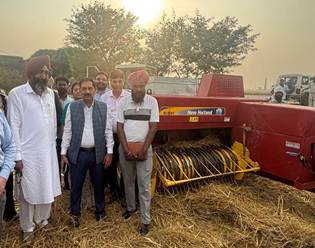
CAQM has emphasised the need for continuous and effective field surveillance by District, Nodal and Cluster Officers, particularly in hotspots viz. low-cost sensors and other monitoring mechanisms and enforcement activities must continue without any lapse. Further, it was directed to ensure close coordination among farmers, aggregators, industries and other stakeholders to strengthen the ex-situ management supply chain and optimal utilisation of CRM machinery, balers, field staff, surveillance systems and control rooms.
CAQM has been continuously monitoring, coordinating and reviewing the measures being undertaken by the concerned State Governments, State Pollution Control Boards and District Administrations for effective prevention of paddy stubble burning. The Commission has reiterated the need for concerted and coordinated efforts by all concerned agencies, along with active facilitation and cooperation of farmers and other stakeholders, to ensure effective prevention of stubble burning during the ongoing paddy harvesting season.
*****
VM/GS/SK
(रिलीज़ आईडी: 2321780) आगंतुक पटल : 110