



Ministry of Science & Technology

प्रविष्टि तिथि: 20 NOV 2026 3:15PM by PIB Delhi
Scientists have cracked a way to tune an exotic form of quantum magnetism in a network by changing the connectivity of the network. This may have applications in quantum devices, for example, in storing quantum information.
Many systems are composed of interacting objects, and that can range from gas in the room to social networks. The hub-and-spoke diagrams showing flight routes in aeroplane magazines illustrate how connectivity allows people to move across cities. Another relatable example is that of superspreaders during COVID, who acted as hubs in spreading the disease.
These are familiar instances that show how different patterns of connections can determine collective behaviour. But these are all classical systems.
A team from the Raman Research Institute (RRI), an Autonomous Institute of the Department of Science and Technology (DST), explored what happens when many quantum objects interact with each other, what sets the collective ordering and how the quantum units organise themselves.
To understand the system, Revathy B. S., the lead author of the new study and a postdoctoral fellow at RRI, and Shovan Dutta, co-author and assistant professor in the Theoretical Physics group at RRI, pictured a square lattice with one vacant site (hole) and all other sites occupied by one electron.
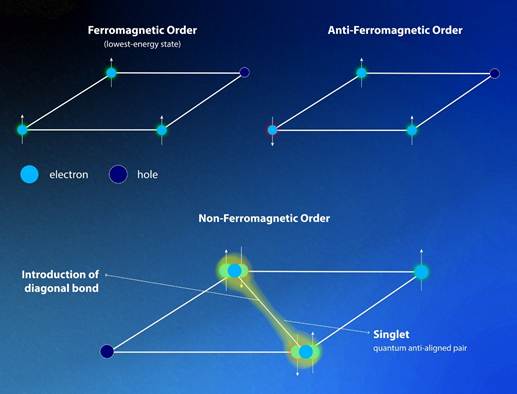
Fig 1: The top row shows the possible magnetic ordering of a many-body quantum system within a single square lattice. The bottom shows that the introduction of a diagonal in the square lattice yield
The electrons have an intrinsic property called spin, which can point up or down. The hole can hop from one site to another, and this motion of the hole can influence how the electron spins arrange themselves, giving rise to what scientists’ call “kinetic magnetism”. Unlike conventional magnetism which arises from direct interactions between the spins, kinetic magnetism arises from the quantum motion (kinetic energy) of particles. Kinetic magnetism is a true quantum-mechanical effect with no classical counterpart.
If all the spins point along the same direction, it is called ferromagnetic order, and if adjacent spins have opposite directions, it is called antiferromagnetic ordering. For a square lattice with one hole, it has been shown before that the lowest-energy state is ferromagnetic.
Revathy and Dutta showed that the magnetic ordering can be varied by the connectivity of the network. For example, introducing a diagonal bond in the square lattice makes the spins of the two electrons involved antiparallel, creating a quantum-mechanically anti-aligned pair of spins, called a “singlet”. The remaining sites retain the ferromagnetic ordering, and the hole keeps hopping across the network.
“What’s amazing is that I can almost deterministically predict that wherever I [introduce a diagonal bond], I will get [singlets],” said Revathy. By introducing a diagonal bond and changing the connectivity locally, they could engineer the global magnetic order. These findings demonstrate that collective quantum order can be shaped by geometry alone.
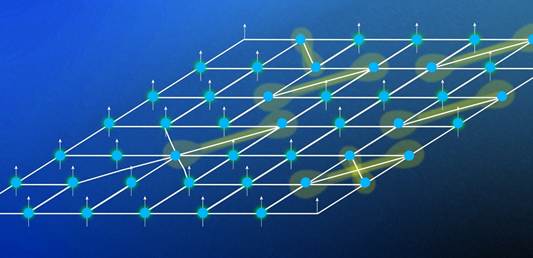
Fig 2: Global magnetic order can not only be determined in a quantum many-body system, but also engineered
“This is far from obvious, because if you had a classical system, similar changes in geometry do not really affect the magnetic order,” said Dutta.
The computational complexity involved prevented physicists from tackling the problem for decades. A lattice with 20 sites yields a mind-boggling two million configurations. Revathy and Dutta used a combination of advanced numerical and analytical approaches to uncover these microscopic patterns and their physical origin.
The research published in Physical Review B is also particularly timely because experimental advances are reaching a stage where researchers can possibly observe the complex theory in action.
Although this work is theoretical, it opens new avenues for shaping quantum states of interacting particles, which may have applications in quantum devices. Our familiar hard drives, for example, use magnetic patterns to store information, but only as classical bits. The singlets in these networks are entangled quantum states and may be used to store quantum information.
Publication Link: https://doi.org/10.1103/stj9-srp1
***
NKR/FT/AA
(रिलीज़ आईडी: 2339007) आगंतुक पटल : 28