



Ministry of Textiles
Union Minister of Textiles releases Report on Mapping of Textile Waste Value Chain in India
India generates 70.73 lakh tonnes of textile waste annually; over 95% of pre-consumer textile waste recovered
Spinning sector achieves near 100% in-situ reintegration, establishing benchmark for circular production
India’s textile recycling market projected to reach USD 3.5 billion by 2030 with potential to create nearly one lakh green jobs
Posted On: 10 MAR 2026 6:53PM by PIB Delhi
Union Minister of Textiles Shri Giriraj Singh today released the report titled “Mapping of Textile Waste Value Chain in India” at an event held at Udyog Bhawan, New Delhi. The report provides a comprehensive assessment of textile waste generation, recovery pathways, recycling technologies and opportunities to strengthen circularity across India’s textile value chain.
Speaking on the occasion, the Union Minister said that India’s textile sector, one of the largest in the world, has significant potential to lead the global transition towards sustainable and circular production systems.
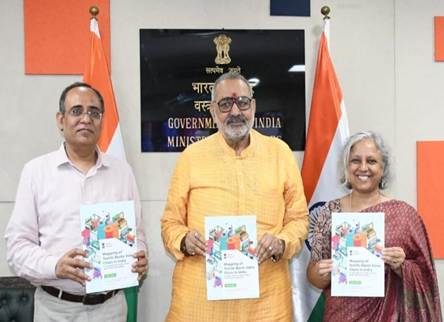
Shri Giriraj Singh stated that India’s textile industry continues to expand rapidly and it is important that this growth is aligned with sustainability goals. He noted that the report provides a data-driven blueprint for transforming textile waste into a valuable economic resource and highlights practical pathways for recycling, upcycling and resource recovery.
The study maps both pre-consumer and post-consumer textile waste streams, identifies recycling practices across clusters, documents emerging technologies and outlines policy recommendations to strengthen India’s circular textile ecosystem.
The report estimates that India generates approximately 70.73 lakh tonnes of textile waste annually. Of this, 42 per cent originates from pre-consumer sources such as manufacturing waste, while 58 per cent arises from post-consumer disposal. More than 70 per cent of the total textile waste is currently recovered and routed into recycling, upcycling, downcycling or reuse streams. The findings further indicate that around 95 per cent of pre-consumer textile waste is recovered, reflecting the strength of recovery networks across the value chain.
The report highlights that the spinning sector has established a benchmark for closed-loop operations, with nearly 100 per cent of spinning waste reintegrated in situ into production. Soft waste generated during spinning is immediately reused within the same process due to homogeneous waste streams, proximity between generation and processing and established quality standards for recycled inputs.
The analysis also notes that about 55 per cent of India’s post-consumer textile waste is diverted from landfills, largely through an extensive informal collection and sorting network. This ecosystem sustains around 40–45 lakh livelihoods, predominantly women from marginalised communities engaged in the collection, sorting and redistribution of used textiles.
Cluster analysis shows that Panipat is emerging as a major hub for mechanical textile recycling, with waste from several textile clusters transported there for processing. The report notes that developing recycling infrastructure at the cluster level across textile hubs could significantly improve efficiency and enable recycling closer to the source of waste generation.
The report further projects that India’s textile recycling market could reach USD 3.5 billion by 2030, with the potential to generate around one lakh new green jobs. Mechanical recycling currently represents the most established pathway for textile recycling, while chemical recycling technologies are gaining traction for their ability to recover fibres at the molecular level and support textile-to-textile recycling.
The Ministry of Textiles reiterated its commitment to promoting sustainable manufacturing practices, circular resource use and innovation in recycling technologies. The findings of the report are expected to support policy formulation, industry collaboration and investments aimed at strengthening India’s position as a global hub for circular and sustainable textiles.
The report is available on the website of the Ministry of Textiles (http://texmin.gov.in/).
*****
MAM/VN
(Release ID: 2237779) Visitor Counter : 109