



Ministry of Education
Union Education Minister addresses concluding session of Post Budget Webinar on “Sabka Saath Sabka Vikas – Fulfilling Aspirations of People” in New Delhi
Posted On: 09 MAR 2026 9:17PM by PIB Delhi
Union Minister of Education Shri Dharmendra Pradhan today addressed the concluding session of the Post Budget Webinar on the theme “Sabka Saath Sabka Vikas – Fulfilling Aspirations of People.” The webinar focused on deliberating key reforms announced in the Union Budget and exploring pathways for their effective implementation in the education sector. The Prime Minister, Shri Narendra Modi, addressed the inaugural session, today.
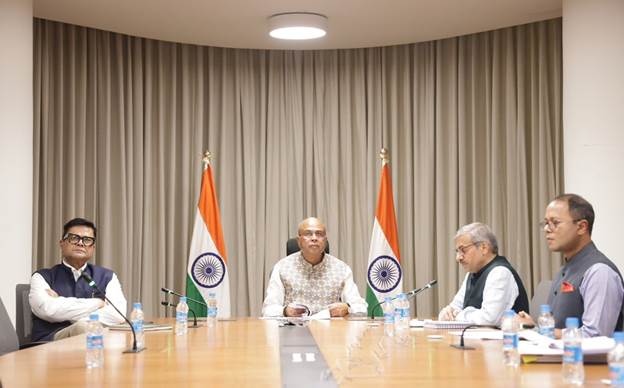
Addressing the webinar, Shri Dharmendra Pradhan said that the huge participation from a diverse set of domain experts and stakeholders reflected participatory governance in the truest sense. He further said that NEP 2020 advocates inclusive and accessible education and added that this year’s budget gives a big push to education, employment, enterprise, innovation and research. He thanked all the stakeholders for their valuable suggestions and insights and expressed confidence that they would play an important role in implementing the budget announcements on the ground.
The discussions focused on strengthening education-to-employment linkages, developing future-ready curricula, expanding skilling pathways, and fostering innovation-driven ecosystems through collaboration among ministries, academia, industry, civil society and implementation partners.
Dr. Jitendra Singh, Minister of Science and Technology; Shri Ashwini Vaishnaw, Minister of Information and Broadcasting; Shri Piyush Goyal, Minister of Commerce and Industry; and Dr. Virendra Kumar, Minister of Social Justice and Empowerment; along with Shri Rao Inderjit Singh, Minister of State (Independent Charge) for Planning; and senior officials and stakeholders attended the webinar.
The Breakout Session 4, led by the Ministry of Education, deliberated on several key initiatives aimed at strengthening human capital development and promoting inclusive growth. These included the Education to Employment & Enterprise Standing Committee, AVGC Content Creator Labs, creation of University Townships, Girls’ Hostels for STEM, the National Telescope Scheme, and Divyang Kaushal Yojana.
Dr. Vineet Joshi, Secretary, Department of Higher Education, Ministry of Education, presented a summary of the outcomes of Breakout Session 4. He highlighted the two sessions led by the Department of Higher Education were on University Townships and Girls Hostel for STEM. The session on University Townships defined the structural blueprint for the first five University Townships, the challenge methodology, corridor aligned academic offerings, governance and options of financing models required to create integrated academic industrial townships. He also said that the session on Girls Hostel for STEM helped us in discussing the district level planning norms, capacity models and grant structures needed for universal hostel availability thereby enhancing women participation in STEM by ensuring that women in STEM have safe, proximate and affordable residential access. He encouraged all the participants to keep on engaging deeply so that today’s insights can translate into concrete results.
The following are the discussions held during the breakout sessions.
1. High-Powered ‘Education to Employment and Enterprise’ Standing Committee
Participants discussed building a future-ready workforce by strengthening the linkage between higher education, skilling, and industry. Emphasis was placed on modernising curricula for AI-driven jobs, expanding research capacity, and establishing public-private Centres of Excellence in frontier technologies. Stakeholders also highlighted the need for regulatory simplification, large-scale teacher upskilling, stronger industry collaboration, and a national outcomes dashboard to track progress.
2. Orange Economy – AVGC Content Creator Lab
The session focused on operationalising Content Creator Labs (CCLs) and strengthening the AVGC ecosystem in alignment with NEP 2020. Participants highlighted the need for standardized lab infrastructure, industry-linked curricula, teacher training, and internships to build a strong domestic talent pipeline. Expanding access to Tier-2 and Tier-3 cities, promoting original IP creation, and positioning India as a global creative and digital content hub were key themes.
3. New National Institute of Design
Participants emphasized the importance of developing a distinct Indian design ethos rooted in cultural narratives and indigenous creativity while remaining globally competitive. Discussions highlighted integrating design thinking early in industry and education, strengthening interdisciplinary learning, and leveraging emerging technologies such as AI. The new NID was envisioned as a catalyst for advancing design literacy, innovation, and global leadership in design.
4. Five University Townships
The session discussed establishing integrated university townships that bring together academia, industry, R&D, and startup ecosystems within a single innovation cluster. Stakeholders highlighted the importance of strong governance structures, NEP-aligned academic reforms, and co-located research and industry facilities. Emphasis was also placed on sustainable urban design, industry collaboration, and inclusion to ensure these townships function as engines of regional economic growth.
5. Girls’ Hostel in Every District for STEM Institutions
Participants emphasized that girls’ hostels should function as comprehensive learning ecosystems with strong safety, accessibility, and academic support systems. Discussions highlighted the need for modern, hygienic, and sustainable infrastructure located close to academic institutions. A cluster-based approach, flexible capacity planning, and strong coordination among ministries and institutions were recommended to enhance women’s participation in STEM education.
6. Divyangjan Kaushal Yojana
The session focused on building an inclusive and scalable skilling ecosystem for persons with disabilities through market-linked training, assistive technologies, and strong industry partnerships. Participants highlighted the need for AI-enabled job-matching platforms, expanded roles in emerging sectors, and sustained post-training support. Emphasis was placed on inclusive workplaces, entrepreneurship support, and robust data systems to track meaningful livelihood outcomes.
7. Four Telescopic Infrastructure Facilities
Participants discussed strengthening India’s global leadership in astronomy through major telescope projects such as the National Large Solar Telescope and National Large Optical Telescope. The session highlighted the need for strong academia-industry collaboration, advanced instrumentation development, and a national talent pipeline in astronomy, optics, and data science. Robust data infrastructure, public outreach, and effective monitoring mechanisms were also emphasised for timely project implementation.
Delivered the concluding remarks of the post-budget webinar on “Sabka Saath, Sabka Vikas—Fulfilling Aspirations of People.”With huge participation from diverse set of domain experts and stakeholders, this is participatory governance in the truest sense.
NEP 2020 advocates for… pic.twitter.com/EUdlLHQ81a
— Dharmendra Pradhan (@dpradhanbjp) March 9, 2026
Addressing the concluding session of the post-budget webinar on ‘Sabka Saath Sabka Vikas—Fulfilling Aspirations of People.’ https://t.co/OJ1yuqUOWI
— Dharmendra Pradhan (@dpradhanbjp) March 9, 2026
The webinar was streamed live and can be accessed at the following link:
https://www.youtube.com/watch?v=oWGIhy24Eos
*****
AK
(Release ID: 2237243) Visitor Counter : 102