



PIB Backgrounder
Global Wind Day 2026
Charting India’s Path to 100 GW and Beyond
Posted On: 14 JUN 2026 1:05PM by PIB Delhi
Setting the Stage: Marking Global Wind Day 2026
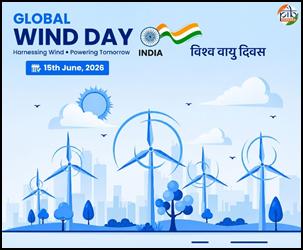
Global Wind Day is celebrated annually on June 15 to promote wind energy and its role in combating climate change. India will host the Global Wind Day 2026 Conference on 15 June 2026 in Goa, under the theme “Wind Energy: From Ambition to Acceleration.” The conference will bring together senior representatives from the Central Electricity Authority (CEA), Solar Energy Corporation of India (SECI), Indian Renewable Energy Development Agency (IREDA), National Institute of Wind Energy (NIWE), Grid India, leading state governments, and industry bodies and associations.
The conference will spotlight key priorities shaping the next phase of India’s wind energy journey, including resource adequacy, grid readiness, capacity addition, domestic manufacturing competitiveness, export opportunities, and advancements in forecasting and renewable energy firming. The conference will also witness the release of the industry report “Elevating India’s Wind Turbine Exports for Global Markets.
India’s Wind Energy Landscape
India’s wind energy sector is expanding steadily with rising installed capacity and strong wind resource potential across key states. It is increasingly supported by domestic manufacturing and its role in meeting renewable energy targets.
Wind Resource Potential
- India’s estimated gross wind power potential is 695.5 GW at 120 metres and 1,163.9 GW at 150 metres above ground level.
- Majority of the assessed wind potential at 150 Meter is concentrated in eight high-resource states: Rajasthan: 284.2 GW; Gujarat: 180.8 GW; Maharashtra: 173.9 GW; Karnataka: 169.3 GW; Andhra Pradesh: 123.3 GW; Tamil Nadu: 95.1 GW; Madhya Pradesh: 55.4 GW, Telangana: 54.7 GW.
- More than 900 wind-monitoring stations have been installed nationwide to map wind resources and identify high-potential sites for wind energy development.
- Wind potential maps have been developed at 50 m, 80 m, 100 m, 120 m, and 150 m hub heights.
- India’s vast wind resource base provides a strong foundation for achieving 100 GW wind capacity by 2030 and 156 GW by 2036.
Wind Capacity and Manufacturing Growth
- India ranks 4th globally in installed wind power capacity.
- Installed wind capacity increased from 21.04 GW in March 2014 to 56.09 GW in March 2026, a 2.66-fold increase.
- An additional 28 GW is under implementation.
- India recorded its highest-ever annual wind capacity addition of 6.05 GW in 2025-26, surpassing the previous record of 4.15 GW in 2024-25.
- Nearly 45% of wind generation occurs during peak demand hours, complementing solar power and strengthening grid reliability.
- Wind Turbine Manufacturing Capacity has increased from 10 GW in 2014 to about 24 GW, as on March 2026.
- The sector has achieved 70-80% indigenisation across key components.
- Strong domestic supply chains exist for blades, towers, gearboxes, and other critical equipment.
Wind energy is becoming a more stable and integrated part of India’s power system.
Its role will expand further with technological upgrades and diversified deployment.
Key Government Interventions
Government priorities focus on expanding wind deployment, offshore development, and grid modernisation. These are supported by targeted schemes, financial incentives, and regulatory reforms.
- ₹6,853 crore Viability Gap Funding (VGF) approved for 1,000 MW of offshore wind projects, comprising 500 MW each off the coasts of Gujarat and Tamil Nadu.
- ₹500 crore disbursed under the Generation Based Incentive (GBI) Scheme during 2025–26.
- A 500 MW pilot project launched under the Contracts for Difference (CfD). CfD is a mechanism designed to reduce price volatility and provide revenue certainty to renewable energy developers.
- A Task Force constituted in January 2026 to address regulatory, land, transmission, and implementation challenges.
- Dedicated wind component introduced under Renewable Purchase Obligations (RPOs) to ensure sustained demand.
- Green Energy Open Access Rules introduced to facilitate direct procurement of renewable power by industries.
- Implementation of the Approved List of Models and Manufacturers (ALMM), transparent bidding guidelines, and Late Payment Surcharge Rules has strengthened investor confidence.
- Promotion of hybrid and Round-the-Clock (RTC) Renewable Energy projects to improve grid efficiency.
Priorities for Wind Energy include:
- Expanding wind deployment into emerging states such as Madhya Pradesh, Telangana, and Odisha.
- Launching India’s offshore wind sector through identified leasing areas in Gujarat and Tamil Nadu.
- Integrating wind power into Round-the-Clock (RTC) Renewable Energy solutions through storage-linked business models.
- Modernising the grid and deploying Artificial Intelligence (AI)-based forecasting tools for renewable energy management.
- Strengthening domestic manufacturing across the entire wind energy value chain.
Global Partnerships in Wind Energy
India is strengthening wind energy cooperation with the UK, Denmark, and Belgium to accelerate sector development. These partnerships focus on offshore wind deployment, advanced technology transfer, and improved grid integration. They also enable knowledge sharing on policy design, financing models, and project execution.
India–United Kingdom:
- The India–United Kingdom Offshore Wind Taskforce was launched in February 2026 under Vision 2035 and the Fourth India–UK Energy Dialogue.
- Focus areas include market design, port infrastructure, supply chains, and blended finance.
India-Belgium:
- At the World Economic Forum (WEF) 2026, India and Belgium reaffirmed cooperation in offshore wind, research and development, and green taxonomy, signalling growing European interest in India’s clean energy transition.
India-Denmark:
- India signed a cooperation agreement with Denmark’s Ministry for Energy, Utilities and Climate in 2019 for offshore wind capacity building.
- The bilateral Memorandum of Understanding (MoU) was renewed in May 2025.
- Cooperation now includes power system modelling, integration of variable renewable energy, and joint expert training.
The Road Ahead for Wind Energy
As India enters the next phase of its energy transition, wind power will play an increasingly important role in delivering reliable, affordable, and domestically sourced clean electricity. The country’s extensive onshore and offshore wind resources provide a strong foundation for long-term growth, but realizing this opportunity will require faster project execution, stronger transmission infrastructure, improved forecasting capabilities, and continued policy support. By expanding into new geographies, integrating wind with storage and round-the-clock power solutions, and strengthening domestic manufacturing and export competitiveness, India can position wind energy not only as a key contributor to its climate and energy security goals, but also as a driver of industrial development and economic growth.
References
Ministry of New and Renewable Energy
******
PIB Research
(Release ID: 2272630) Visitor Counter : 332