


































PIB Headquarters

Union Budget FY 2026-27: A Push for India’s Services Exports
Building on India’s strong services export performance
Posted On: 14 MAR 2026 9:34AM by PIB Delhi
|
Introduction
India’s services sector has emerged as one of the strongest performers of the economy, playing an increasingly important role in driving growth, productivity, and global integration. According to the World Bank, the share of services in India’s GDP rose to 49.9% in 2024, which is about 1.5 percentage points above the pre-pandemic average, an increase greater than the global average and the majority of developed economies. This expansion has been supported by productivity improvements driven by rapid adoption of digital technology and deeper integration of Indian firms into the global value chain.
The Union Budget 2026-27 further reinforces this trajectory through targeted tax reforms for IT services, incentives for cloud and data centres, simplified compliance mechanisms, and trade facilitation measures aimed at enhancing India’s global competitiveness in services trade. It also envisions making India a global leader in services, with a 10% global share by 2047 and in order to achieve this goal, setting up of a high level ‘Education-to-Empowerment and Enterprise’ Standing Committee has been proposed for Viksit Bharat.
The Committee will focus on identifying high-potential services sub-sectors capable of generating growth and employment. It will also address cross-sectoral policy and regulatory issues, including standards and accreditation frameworks, and explore avenues to further expand India’s services exports. The Committee will also assess the impact of AI and emerging technologies on jobs and skills, while proposing measures for AI integration in education, workforce upskilling and reskilling, AI-enabled job matching, formalisation of informal work, and attraction of global talent and skilled diaspora.
As the services sector evolves, services trade has emerged as an important contributor to India’s external sector performance, with rising exports supporting overall trade growth amid changing global conditions.
India’s Services Export Performance and Drivers
Growth and Recent Performance
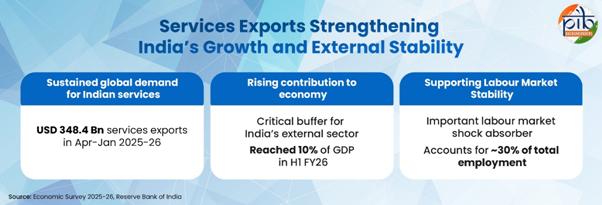
India’s services exports have maintained strong momentum in FY2025-26, supported by sustained global demand for Indian services. Over the period April-January 2025-26, services exports are estimated at USD 348.4 billion.
|
Rising Contribution of Services Sector in Economic Growth Amid geopolitical disruptions, services exports have emerged as a critical buffer for India’s external sector, helping mitigate external vulnerabilities and sustain trade stability. The increasing importance of services exports is clearly reflected in their rising contribution to overall economic activity. Growing Share in GDP: India’s services exports share in GDP averaged 9.7% during FY23-FY25, marking a notable rise from 7.4% in the pre-pandemic period, and highlighting the growing role of the services sector in supporting economic growth. This stabilising contribution strengthened further in the first half (H1) of FY26, with the share of services exports in GDP increasing to 10%, highlighting the continued expansion and resilience of India’s services-led growth trajectory. Supporting Labour Market Stability: The services sector has also emerged as a major source of employment generation. It accounts for nearly 30% of total employment. Over the past six years, the sector added nearly 40 million jobs, in the post-COVID recovery period, highlighting its role as an important labour market shock absorber. |
Sectoral Drivers of Services Exports
According to the RBI’s survey on computer software and information technology-enabled services (ITES), software services exports increased by 7.3% year-on-year in FY25, reflecting sustained momentum in India’s digital services exports. During this period, computer services accounted for over two-thirds of India’s total software services exports, while BPO services remained the most significant component of ITES exports.
This strong performance reflects the broader resilience of India’s services sector, supported by the sustained expansion of software, BPM, consulting, and fintech segments, which continue to drive overall services exports. Supported by robust global demand for digital services, software services remain the largest component. It accounts for over 40% of total services exports and has expanded at an average rate of 13.5% during FY23-FY25 compared to 4.7% in FY16-FY20. Alongside this, business services exports have gained momentum in recent years, reinforcing the sector’s expanding contribution to India’s external sector strength. In FY23-FY25, Professional and management consulting has emerged as the second-largest contributor, growing at 25.9% and thereby resulting in increasing its share from 10.5% in FY16-FY20 to 18.3% in FY23-FY25 .
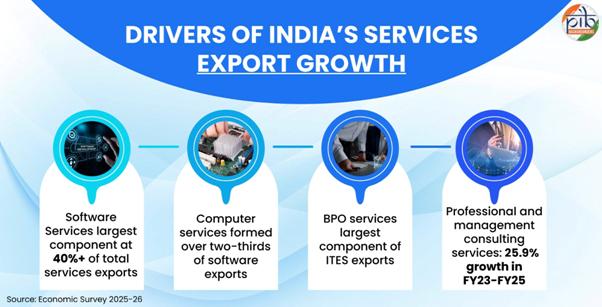
Together, these segments account for over 65% of services exports, highlighting India’s growing specialisation in cross-border and knowledge-intensive activities.
Budget Focus on Services Sector: A Push for the Economy
India has established itself as a global leader in software development, IT-enabled services, knowledge process outsourcing, and software-related contract R&D services. Recognising this strong global position, the Union Budget 2026-27 proposed a range of reforms aimed at supporting and facilitating the growth of the IT and IT-enabled services sector.
Boosting Cloud Services Exports through Data Centre Incentives
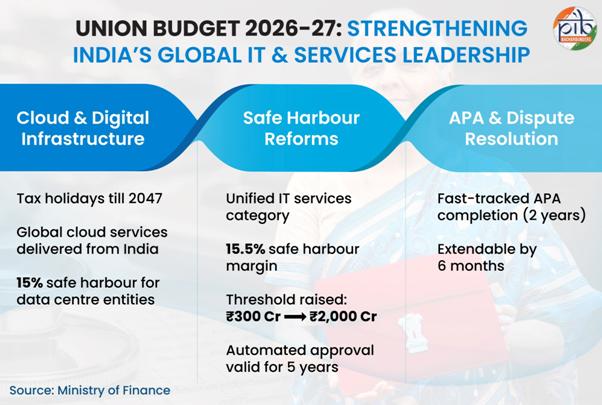
One of Union Budget’s most distinctive initiatives is the introduction of incentives to attract global cloud service providers operating through India-based data centre infrastructure. Recognising the need to enable critical infrastructure and boost investment in data centres, the Budget proposes tax holidays until 2047 for foreign companies delivering cloud services to global clients using infrastructure located in India. In addition, related entities providing data centre services from India are proposed to benefit from a safe harbour margin of 15% on costs.
Safe Harbour Reforms for IT Services
To simplify compliance, the Union Budget proposed to consolidate software development services, IT enabled services, knowledge process outsourcing services, and contract R&D services relating to software development, under a single category of Information Technology services with a common safe harbour margin of 15.5%, while increasing the safe harbour threshold for IT services from ₹300 crore to ₹2,000 crore.
The safe harbour regime shall also be approved through an automated rule-driven process without the need for tax officer, and once opted for, IT services companies will be allowed to continue under the same safe harbour provisions for a period of five consecutive years at their discretion.
Advance Pricing Agreement (APA) Reforms
For IT services companies who want to conclude Advance Pricing Agreement (APA), the Budget also proposes to fast-track the Unilateral APA process for IT services companies, with an objective of concluding agreements within 2 years. The period of 2 years can be extended by a further period of 6 months on taxpayer’s request. The facility of filing modified returns available to entities entering into an APA is also proposed to be extended to their associated entities.
|
Unilateral Advance Pricing Agreement (APA) Unilateral Advance Pricing Agreement (UAPA) under the Income-tax Act, 1961 refers to an agreement entered into between a taxpayer and the Central Board of Direct Taxes (CBDT) to determine, in advance, the price charged or its determination, for specified international transactions or specified domestic transactions, for a fixed period of time. |
Additional Budget Initiatives for Supporting Services Sector
The Union Budget FY 2026-27 has also introduced initiatives aimed at strengthening India’s services ecosystem through skill development. Some of them relate to traditional medicine, medical value travel and tourism-linked infrastructure.
- Developing skilled Care givers: A strong Care Ecosystem, covering geriatric and allied care services will be built. A variety of NSQF-aligned programmes will be developed to train multiskilled caregivers combining core care and allied skills, such as, wellness, yoga and operation of medical and assistive devices. In the coming year, 1.5 lakh caregivers will be trained.
|
Strengthening India’s Care Economy Driven by rapidly aging populations, increased life expectancy, and a rise in chronic diseases, the demand for caregivers has been increasing globally. According to ILO , plugging existing, significant, gaps in care services could generate almost 300 million jobs. Against this backdrop, the announcements of Budget 2026-27 in developing a strong Care Ecosystem, covering geriatric and allied care services is expected to expand the pool of India’s care giver professionals who can significantly contribute to this global demand. |
- AYUSH: As India focuses on expanding the global reach of AYUSH, the announcements in Budget 2026-27 are expected to enhance the global acceptability and recognition of these traditional branches of medicine along the lines of the massive global recognition that Yoga has achieved today. The following measures have been announced:
- Setting up of 3 new All India Institute of Ayurveda
- Upgradation of the WHO Global Traditional Medicine Centre in Jamnagar that will bolster evidence-based research, training and awareness for traditional medicine.
- Upgradation of the AYUSH pharmacies and Drug Testing Labs for higher standards of certification ecosystem
- Boosting Tourism: A host of measures have been announced for boosting tourism which includes the following:
- Medical Value Travel: Aimed at positioning India as a global hub for medical value tourism, the government will be supporting the setting up of five regional medical tourism hubs in partnership with the private sector.
- Upskilling of Guides: Launching a pilot scheme to upskill 10,000 guides across 20 iconic destinations. This initiative features a 12-week hybrid training programme developed in collaboration with the Indian Institute of Management (IIM).
- Development of Archaeological Sites: Boosting heritage and cultural tourism by developing 15 major archaeological sites, including Lothal, Sarnath, and Hastinapur, into world-class experiential hubs. The initiative focuses on enhancing visitor infrastructure, promoting sustainable tourism, and launching a new Buddhist Circuit in the Northeast to boost religious tourism.
- Focus is also on building on India’s potential and opportunity to offer world-class trekking and hiking experiences.
- High-Speed Rail for Tourism Connectivity: The proposed high-speed rail routes (Mumbai–Pune; Pune–Hyderabad; Hyderabad–Bengaluru; Hyderabad–Chennai; Chennai–Bengaluru; Bengaluru–Varanasi, and Varanasi–Siliguri) aims to potentially cut travel times between major business centres and culturally significant destinations.
New Drivers of Services Export Competitiveness
Rising GCC Footprint
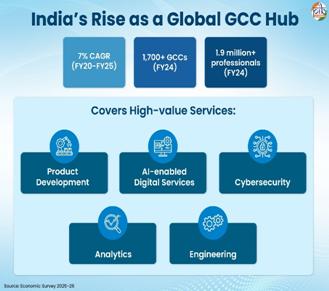
India’s expanding services exports are increasingly supported by the country’s emergence as a global hub for Global Capability Centres (GCCs), which grew at a compound annual growth rate (CAGR) of around 7% between FY20 and FY25. GCCs have become a key channel through which services are delivered cross-border from India. As of FY24, India hosts over 1,700 GCCs employing more than 1.9 million professionals, making it the world’s largest hub for captive global operations.
Over time, GCCs have evolved from support-oriented functions into integral components of multinational firms’ global operations undertaking high-value activities such as product development, AI-enabled digital services, cybersecurity, analytics, and engineering, directly contributing to India’s exports of knowledge-intensive and digitally delivered services. Their expansion has been supported by India’s labour arbitrage, strong physical and digital infrastructure, cost competitiveness, SEZ-linked incentives, and a vibrant startup ecosystem, all of which enhance overall efficiency.
India’s AI and Digital Ecosystem
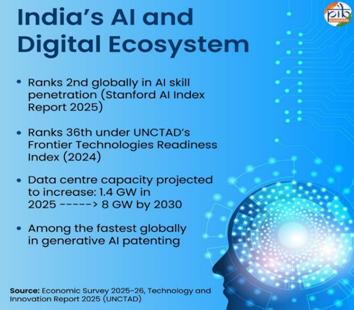
India’s growing capabilities in artificial intelligence and digital technologies further reinforce this export growth. According to the Stanford AI Index Report 2025, India ranks second globally in AI skill penetration , reflecting the availability of advanced digital talent supporting global service delivery. International organisations also highlight India’s improving technological readiness, with the country rising from 48th in 2022 to 36th in 2024 under UNCTAD’s Frontier Technologies Readiness Index. India additionally ranks among the leading countries in cloud infrastructure services , supported by one of the world’s largest populations that can leverage a significant mass of AI developers.
Rapid growth in data consumption, cloud adoption, and AI deployment is accelerating investments in digital infrastructure, with India’s data centre capacity projected to increase from around 1.4 GW in 2025 to nearly 8 GW by 2030. This expansion strengthens India’s ability to deliver digitally enabled services globally. The country’s rising innovation ecosystem is reflected in growing AI start-ups , venture investment, and one of the fastest growth rates in generative AI patent filing worldwide.
Global Trade Agreements Boosting Services Exports
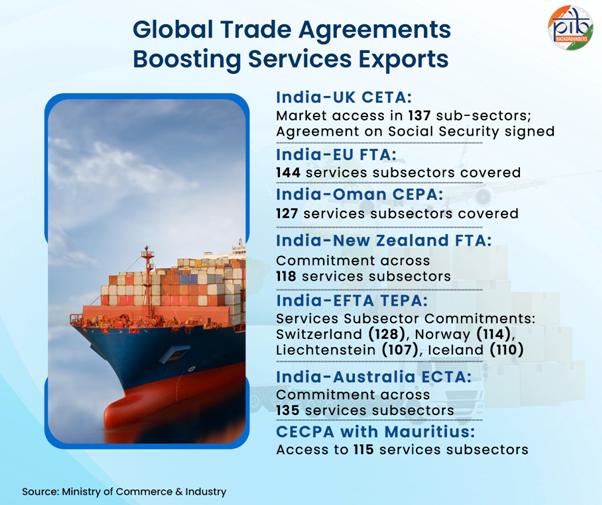
India’s expanding network of trade agreements has played an important role in strengthening market access for its services sector across global markets. These agreements provide greater mobility for professionals, and new opportunities for Indian service providers across a wide range of services.
India-UK CETA
- Expanded Market Access: UK has provided comprehensive and deep market access in 137 sub-sectors in areas of India’s interest such as IT/ITeS, Business Services, Professional Services, Financial, Telecom and Education services.
- Easier Access for Indian Professionals: Indian professionals will benefit from simplified visa procedures and liberalised entry categories, making it easier to work in the UK. These professionals are deployed by companies to work in UK across all service sectors and those on contracts such as architects, engineers, chefs, yoga instructors, and musicians.
- Agreement on Social Security: Both sides also reached an understanding during signing of the CETA to conclude an Agreement on Social Security, which will come into force at the same time as CETA. Accordingly, an Agreement on Social Security relating to Social Security Contributions has been signed by both countries on 10th February 2026. It seeks to avoid double social security contributions for employees of both countries on temporary assignments in each other’s territories for periods of up to 36 months.
The Agreement on Social Security Contributions along with mobility and market access commitments in CETA is expected to enhance India-UK partnerships in the service sector, leveraging the high skills and innovative service sectors of both countries.
India-EU Free Trade Agreement (FTA)
- Expanded Market Access: The EU has extended commitments across 144 services subsectors, including IT/ITeS and professional services, enabling Indian providers to expand exports and support innovation, productivity and business growth across both economies.
- Mobility and Social Security Support: Facilitative provisions have also been built to facilitate mobility of Indian AYUSH practitioners to EU, mobility of Indian students to EU as well as maintain/conclude/adopt social security arrangements between India and EU member states.
India-Oman Comprehensive Economic Partnership Agreement (CEPA)
- Expanded Market Access: Oman has taken commitments across 127 services subsectors, including professional services, computer and related services and audio-visual services. For the first time in any FTA, Oman has committed for a defined category of professionals, including accounting, engineering, medical, IT, education, construction and consulting services. A framework for cooperation has been put in place in the area of health and traditional medicine.
Expanded ICT Ceiling: The ceiling for Intra-Corporate Transferees (ICTs) has been enhanced from 20% to 50%, enabling Indian companies to deploy a larger number of managerial and specialist personnel.
India-New Zealand Free Trade Agreement (FTA)
- Expanded Market Access: New Zealand has offered commitment across 118 services sectors. Facilitative provisions have been built in for promoting trade in Ayurveda, yoga, and other traditional medicine services with India, and enabling Mobility and Post Study Work for Indian students.
- Visa Access for Skilled Indians: A quota of 5,000 visas for skilled Indians for stay upto 3 years in the sectors of interest to India has also been committed by New Zealand.
These provisions create unprecedented opportunities for Indian youth and professionals to gain global exposure.
India-European Free Trade Association (EFTA) Trade and Economic Partnership Agreement (TEPA)
- Expanded Market Access: Under the TEPA, 128 sub-sectors have been committed by Switzerland, 114 by Norway, 107 by Liechtenstein, and 110 by Iceland. It also offers binding commitment of $100 bn investment and 1 million direct jobs in the next 15 years.
- Enhanced Mobility Provisions: EFTA has offered mobility FTA plus commitments in a range of service sectors/sub-sectors under Contractual Service Suppliers and Independent Professionals.
- Mutual Recognition Agreements (MRAs): Mutual Recognition Agreements (MRAs) have been enabled in professional services such as nursing, chartered accountancy, and architecture.
India-Australia Economic Cooperation & Trade Agreement (Ind-Aus ECTA)
- Expanded Market Access: Under the ECTA, Australia has provided commitments across nearly 135 sub-sectors.
- Enhanced Mobility Provisions: Australia has also extended high quality temporary entry and temporary stay commitments (up to 4 years) for Intra Corporate Transferees, Contractual Service Suppliers and Independent Executives. Besides commitments on Business Visitors and Installers and Servicers have also been undertaken. Post study work visa up to 4 years for Indian students will also be provided.
- Offshore Tax Relief: As per the agreement under IAECTA, Australia also amended their domestic taxation law to stop the taxation of offshore income of Indian firms providing technical services to Australia. This has enabled Indian Tech Companies to enhance their competitiveness in the international market.
Comprehensive Economic Cooperation and Partnership Agreement with Mauritius
The agreement grants Indian service providers access to around 115 subsectors across key service industries, expanding opportunities and strengthening bilateral economic cooperation.
|
Global Investment Strengthening Services Exports Rising foreign investment in India’s services sector support the rapid expansion of Global Capability Centres and deepening international trade partnerships, which have helped in strengthening India’s position as a preferred destination for globally delivered services. Services-sector FDI inflows accounted for an average 80.2% of total FDI during FY23-FY25, up from 77.7% in the pre-pandemic period, reflecting growing investor confidence in India’s services export ecosystem. Investment has remained concentrated in information and communication services (25.8%) and professional services (23.8%), reflecting India’s strength in digital and knowledge-intensive activities. These sectors highlight how digitally enabled and knowledge-intensive services, supported by global partnerships, continue to drive foreign investment aligned with India’s expanding services exports. |
Conclusion
India’s services exports have recorded strong and consistent growth in recent years, emerging as one of the most resilient drivers of the country’s external sector performance. Building on its kartavya, the Union Budget 2026-27 further reinforces services export growth through targeted tax reforms, digital infrastructure incentives, skill development initiatives, and measures aimed at enhancing global competitiveness of India’s services sector.
With talent, technology, and global partnerships converging, India’s services sector stands poised to carry the nation’s growth story onto the global stage.
References
Ministry of Finance
https://www.indiabudget.gov.in/economicsurvey/doc/echapter.pdf
https://www.indiabudget.gov.in/doc/budget_speech.pdf
https://www.pib.gov.in/PressReleasePage.aspx?PRID=2219981®=3&lang=2
https://incometaxindia.gov.in/Rules/Income-Tax%20Rules/103120000000007832.htm
https://www.indianembassyusa.gov.in/pdf/advance_pricing_agreement_guidance_with_faqs_(tpi-43).pdf
https://incometaxindia.gov.in/Rules/Income-Tax%20Rules/103120000000007189.htm
Ministry of Commerce & Industry
https://www.pib.gov.in/PressReleasePage.aspx?PRID=2228785®=3&lang=1
https://www.pib.gov.in/PressReleasePage.aspx?PRID=2219146®=3&lang=1
https://static.pib.gov.in/WriteReadData/specificdocs/documents/2025/dec/doc20251218737701.pdf
https://www.pib.gov.in/PressReleasePage.aspx?PRID=2207583®=3&lang=2
https://www.pib.gov.in/PressReleasePage.aspx?PRID=2173138®=3&lang=2
https://www.pib.gov.in/PressReleasePage.aspx?PRID=1812730®=3&lang=1
https://www.pib.gov.in/PressReleaseIframePage.aspx?PRID=1708794®=3&lang=2
https://www.pib.gov.in/PressReleasePage.aspx?PRID=2220413®=3&lang=2
https://www.commerce.gov.in/wp-content/uploads/2026/03/FTAs-achievement.pdf
https://www.pib.gov.in/PressNoteDetails.aspx?NoteId=156654&ModuleId=3®=3&lang=2
Reserve Bank of India
https://rbidocs.rbi.org.in/rdocs/PressRelease/PDFs/PR1208964F52A6DCBA464A91D091157FBCEC65.PDF
https://rbidocs.rbi.org.in/rdocs/PressRelease/PDFs/PR14286754E6C89EA04E6FBCE6626CE3CDF389.PDF
https://rbidocs.rbi.org.in/rdocs/PressRelease/PDFs/PR21919AC9681140584EFDB0D359321C6149A5.PDF
International Institutions
https://unctad.org/system/files/official-document/tir2025ch3_en.pdf
***
PIB Research
(Release ID: 2240065) Visitor Counter : 176