






























Ministry of Power
प्रविष्टि तिथि: 14 OCT 2026 7:53PM by PIB Delhi
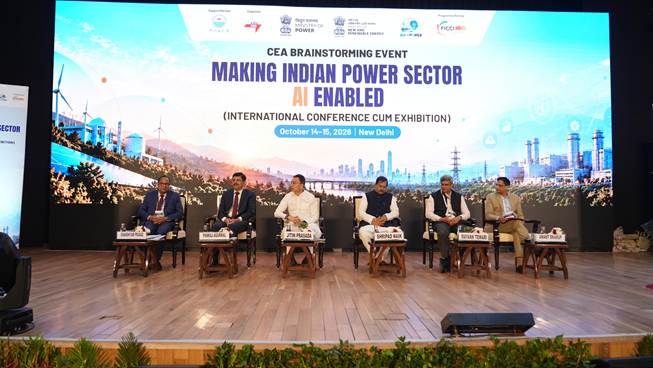
Under the theme “Making Indian Power Sector AI Enabled”, the Central Electricity Authority (CEA) held the first day of its two-day international conference-cum-exhibition at Manekshaw Centre, New Delhi, on 14 October 2026.
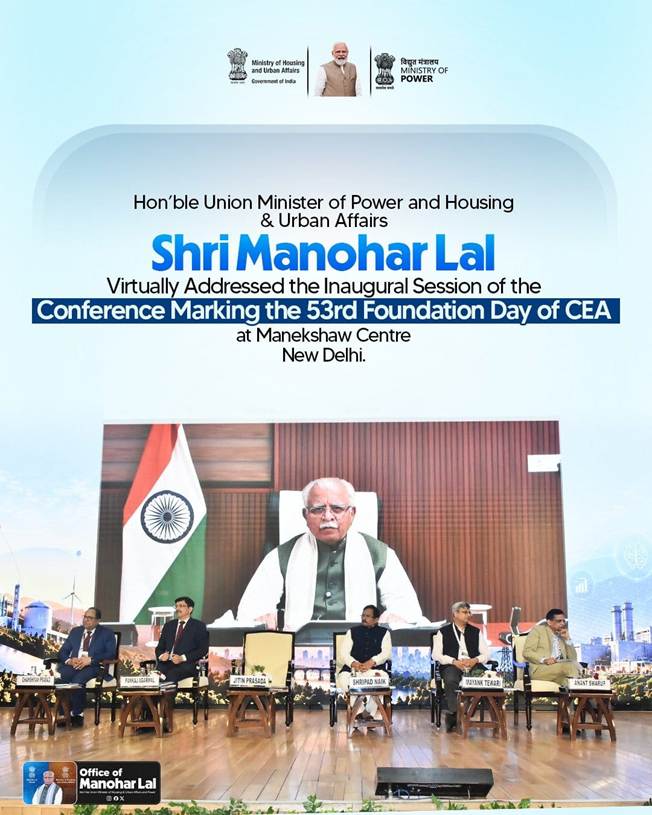
Shri Manohar Lal, Union Minister for Power and Housing & Urban Affairs and Shri Prahlad Joshi, Union Minister of Education, Consumer Affairs, Food and Public Distribution & New and Renewable Energy Government of India, conveyed their messages on the occasion. Shri Shripad Yesso Naik, Union Minister of State for Power and New & Renewable Energy; Shri Jitin Prasada, Union Minister of State for Commerce & Industry and Electronics & Information Technology; Shri Pankaj Agarwal, Secretary, Ministry of Power; Shri Ghanshyam Prasad, Chairperson, CEA ; Shri Mayank Tewari, Additional Secretary, Ministry of New and Renewable Energy; were also present during inauguration.
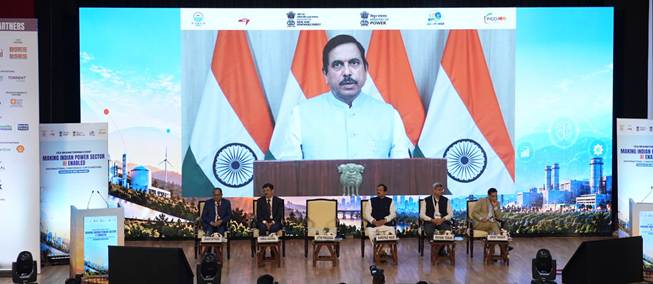
The inaugural session featured addresses by senior government dignitaries and the leadership of CEA. Shri Pankaj Agarwal, Secretary, Ministry of Power and Shri Mayank Tewari, Additional Secretary, Ministry of New and Renewable Energy, addressed the gathering, highlighting the importance of advancing India’s power sector in response to emerging challenges and technological developments. Further, Shri Ghanshyam Prasad, Chairperson, CEA, set the context for the conference. It was highlighted that CEA has already formed a team of 54 artificial intelligence (AI) enthusiast/ brand ambassador. They will take it forward in all areas of power sector. All power utilities may also have dedicated AI team.
The session also saw the launch of CEA’s Vidhyut Dwar Portal and the release of the CEA Manual on Transmission Planning Criteria, 2026. The CEA Employee Awards were also distributed during the session, recognising outstanding performance and exceptional contributions by CEA employees.
The event brought together stakeholders from the power sector to deliberate on practical applications of AI across generation, regulation, renewable energy integration, transmission and distribution systems. The technical programme on Day 1 featured six parallel thematic discussions: Optimizing Generation through AI for Conventional Sources; Regulatory Reforms using AI; AI-Enabled Renewable Energy Integration for a Flexible Grid; Modernising Distribution through AI; Transmission Modernization, Grid Stability and System Restoration through AI; and AI-Enabled Rooftop Solar, Microgrids and Mini-Grids.
The session on conventional generation examined how AI may support heat-rate and combustion optimisation, flexible plant operation, predictive maintenance, digital twins, auxiliary-power optimisation and emissions monitoring. These applications may help improve plant availability and operational efficiency while enabling conventional stations to respond more flexibly to changing system requirements as renewable energy expands.
Discussions on regulatory reforms considered the use of AI, advanced analytics and digital tools for reviewing aggregate revenue requirement and tariff filings, validating submissions, organising regulatory knowledge, monitoring compliance and supporting market surveillance. The discussions also highlighted that AI may function as a human-supervised decision-support tool and may not replace statutory judgment, procedural fairness or regulatory accountability.
The session on renewable energy integration explored AI-based forecasting of variable renewable generation and demand, improved visibility of distributed energy resources, storage optimisation, congestion management and coordination of renewable assets through virtual power plants. The focus was on enabling a flexible and reliable grid through better data, forecasting and coordination of resources.

Modernisation of distribution systems was discussed with reference to the growing availability of smart-meter, network and asset data. Potential applications included demand forecasting, power-procurement optimisation, predictive maintenance of distribution transformers, outage detection and fault localisation, energy auditing, loss analytics, billing and revenue assurance, consumer services and regulatory reporting. These applications may support more reliable supply, lower losses and more responsive consumer services.
The discussion on transmission modernisation and grid stability examined AI-enabled network planning, corridor and right-of-way optimisation, drone-based inspection and computer vision, predictive maintenance, digital twins, dynamic line rating, congestion and contingency analysis, inertia forecasting, and decision support for system restoration and black-start preparedness. Participants considered the data, digital infrastructure, cybersecurity, governance and capacity-building requirements that would support adoption at scale.
The session on AI-enabled rooftop solar, microgrids and mini-grids focused on intelligent planning and operation of decentralised energy resources. Topics included rooftop solar identification and sizing, feeder-level forecasting, autonomous microgrid operation, storage optimisation, agriculture-feeder analytics, demand response and aggregation of rooftop solar, batteries, electric vehicles and flexible loads.
Across the discussions, a common theme was the need to move from isolated technology demonstrations towards prioritised, implementable use cases supported by reliable data, interoperability, appropriate safeguards, institutional capability and measurable performance indicators. The deliberations are intended to inform practical pathways for responsible adoption and scaling of AI applications in the Indian power sector.
The two-day brainstorming event is being organised as part of overall initiative aims to develop a coordinated and outcome-oriented approach to AI adoption across the electricity value chain, supporting efficient and flexible power supply, reliable and intelligent networks, responsive institutions, secure digitalisation and resilient domestic industrial capability.
***********
NR/AP
(रिलीज़ आईडी: 2323545) आगंतुक पटल : 29