


































National Human Rights Commission
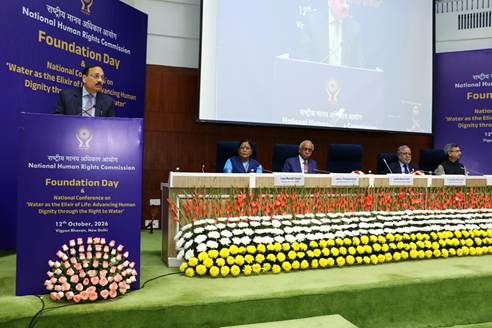
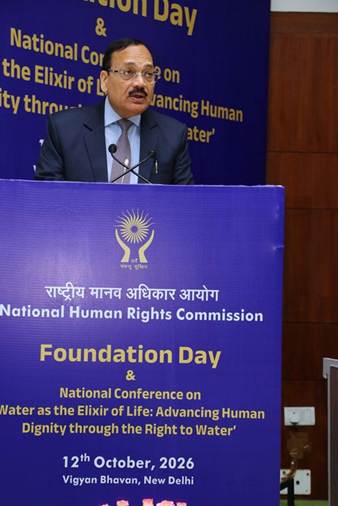
Addressing the gathering as the Chief Guest, Chief Justice of India, Justice Surya Kant lauds the NHRC’s work over the years. Describes the Commission as a guiding light to those adrift in the darkness
Says, SHRCs have a significant role to play, given their proximity to the ground where human rights violation occurs
Commending NHRC for organising the National Conference on Water as the Elixir of Life, the CJI says, the right to water must be understood not only as a right of the present but as a responsibility towards the future
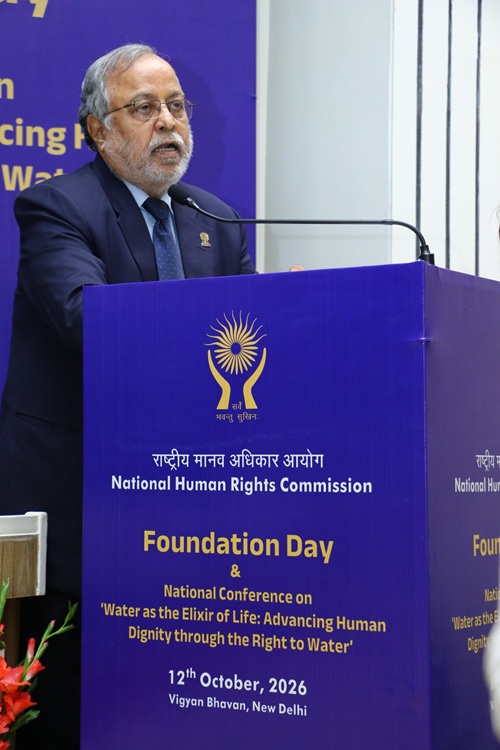
NHRC Chairperson, Justice V. Ramasubramanian says, given the complex challenges facing the world today, human rights institutions throughout the world need to reinvent themselves to continue to be relevant
प्रविष्टि तिथि: 12 OCT 2026 6:33PM by PIB Delhi
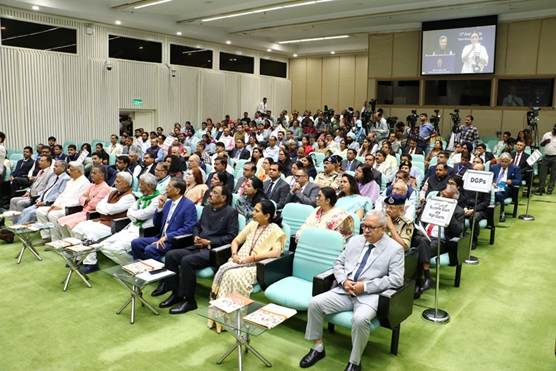
The National Human Rights Commission (NHRC), India today organised a function and National Conference on the theme ‘Water as the Elixir of Life: Advancing Human Dignity through the Right to Water’ to celebrate its 33rd Foundation Day at Vigyan Bhawan, New Delhi. The Commission was set up on 12th October 1993. Addressing the function as the Chief Guest, Chief Justice of India, Justice Surya Kant said that the Constitution of India has made extensive promises to every citizen, including for dignity, equality, liberty and justice. These words in the preamble are among the finest ever written and they must be observed day after day in the field, in the lockup, in the hospital ward and in the village at the end of the road.
Lauding the NHRC’s work over the years, Justice Kant said that people sometimes say that “the Commission can only recommend and cannot command, but I would offer an alternative perspective. Picture, for a moment, a solitary lighthouse standing steadfast at the edge of society’s vast, restless sea. Its purpose is not to steal the waves of injustice but to cast a guiding light for those adrift in the darkness.” He said that Human Rights Commissions must investigate complaints, identify systemic failures and ensure that concerns which may otherwise remain invisible receive institutional attention. Civil society can bring ground realities to the forefront while international institutions can contribute scientific knowledge, experience and cooperation.
Justice Surya Kant said that the true measure of a human rights institution is therefore not only the number of cases it decides but whether it can be heard by those who are least able to make themselves heard. This is where the Human Rights Commissions, particularly the State Human Rights Commissions (SHRCs), have a significant role to play. In a country as large and diverse as India, the experience of rights is often determined not in the capital, but in a remote village, a particular neighbourhood or even the household. The National Commission can set standards and draw attention to larger patterns, but State Commissions are often closer to the ground where violations occur. They can hear a complaint in the language in which it is made, reach the place where it has occurred and understand the local circumstances in which it has taken place. That proximity gives them not merely an administrative advantage, but a life-altering responsibility.
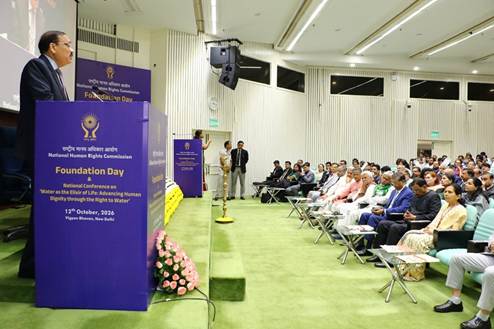
He also commended the Commission for pairing the celebration with the National Conference on ‘Water as the Elixir of Life.’ He said that the right to water must therefore be understood not only as a right of the present but also as a responsibility towards the future.
Justice Kant said that India itself has made astronomical efforts to expand access to drinking water, including through the provisions of household tap connections in rural areas. That progress deserves commendation, but the next question must be a more demanding one. Is the water safe, reliable and available when the family needs it? Therefore, “the Government must build and maintain the systems through which water reaches people. Courts must intervene when constitutional rights are violated.”
He also appreciated the Commission for the launch of the NHRC, India mobile application and the move towards digitisation of its records. He said that this App make the Commission more accessible to those who have traditionally found it difficult to approach formal institutions.
Before this, thanking the CJI for accepting the invitation to be the Chief Guest for the Foundation Day, NHRC Chairperson, Justice V. Ramasubramanian said that “the office of the CJI has become the single most important, the most powerful, the most vibrant, at the same time, the most vulnerable office of the country which is put to the test of fire (Agni Pariksha), every day, nay, every minute, not necessarily by sacred souls at all times.”
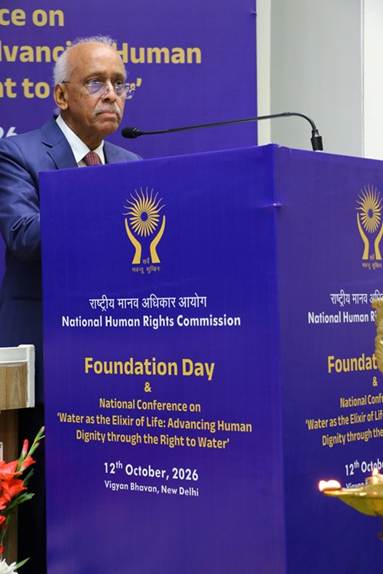
The Chairperson said that “there can be no disagreement on the fact that the world today is a much better place to live than it was hundred years ago. But at the same time, the challenges that we face today are more complex than ever. Therefore, it is the necessity of time that human rights institutions throughout the world reinvent themselves to continue to be relevant.”
Justice Ramasubramanian said that the poorest half of the world’s population is responsible for only 14% of global CO₂ emissions. The world’s richest 10% are responsible for half of all emissions. It is no coincidence that climate and wealth are so closely linked, as they essentially share a common origin: fossil capitalism. Fossil fuels are the source of humanity’s extraordinary progress over the past two centuries but also the source of the extraordinary problems facing us today.
He said that until a few decades ago, our approach to human rights issues was normally two- dimensional. We presumed that it was citizen versus State. But it is not so anymore. Non-State actors now play a huge role, especially after the digital revolution has happened. Today, in the digital world, our opinions can be manipulated, our thought processes can be influenced and our activities, both physical and mental, can be monitored. Therefore, it is time for us, especially when we celebrate NHRC Foundation Day, to take a pledge to reinvent ourselves to face new challenges, reaffirm our commitment to the cause of promotion and protection of human rights and re-engineer our personalities to improve our delivery system.
Earlier, NHRC Member, Justice (Dr.) Bidyut Ranjan Sarangi said that the Commission is committed to promoting and protecting human rights of all including the right to dignity and equality in accordance with the law and the Constitution. In the 33 years of NHRC, there may have been some ups and downs, but it remains committed to its responsibility to serve the cause of human rights. It has expanded its outreach to the doorsteps of the victims of human rights violations through its open hearing and camp sittings.
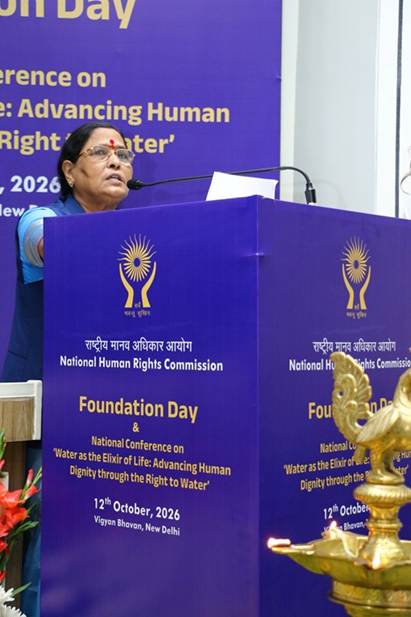
NHRC Member, Smt. Vijaya Bharathi Sayani said that the concept of human rights is deeply rooted in ancient Indian civilisation, which is also reflected in the Constitution of the country. Quoting Rigvedas and Upanishads, she highlighted that India’s ancient scriptures guided us on how to live together with mutual respect and protect human dignity and wellbeing of all through dialogue and collective strength. Therefore, she said that we must take pride in our heritage and work as equal stakeholders for the protection of eights of girls, children and women, among other vulnerable groups.
In his opening remarks, NHRC Secretary General, Shri Piyush Goyal gave an overview of various dimensions of the Commission’s work towards promoting and protecting life. He said that the subjects of human rights are evolving with time. Climate change and digital world are throwing new challenges. He said that as part of its 33rd Foundation celebration, the Commission has organised a National Conference on the theme ‘Water as the Elixir of Life: Advancing Human Dignity through the Right to Water.’ The two technical sessions include ‘Protection and Restoration of Water Bodies: Safeguarding the Foundation of the Right to Water’ and ‘Protecting Drinking Water Sources: Ensuring Safe and Sustainable Access to Water for All.’ He expressed the hope that the deliberations would result in meaningful recommendations.
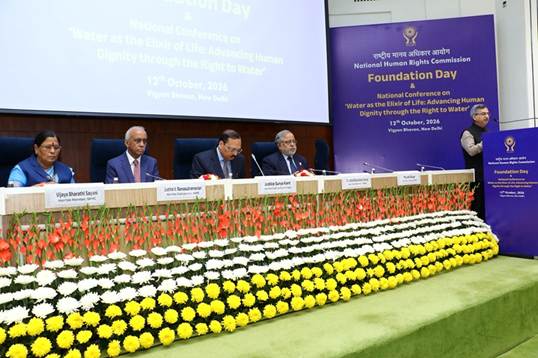
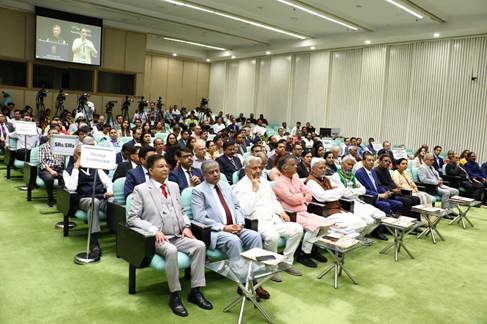
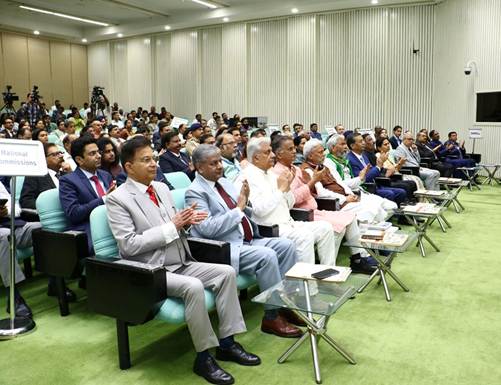
Former NHRC Members, Secretary General, Chairpersons and Members of State Human Rights Commissions and other Commissions, members of the judiciary, the diplomatic community, international organisations and civil society, Special Monitors and Special Rapporteurs, senior government officers, academia, human rights defenders, researchers and NHRC senior officers, among others, attended the function.
*****
NSK
(रिलीज़ आईडी: 2322423) आगंतुक पटल : 21