


































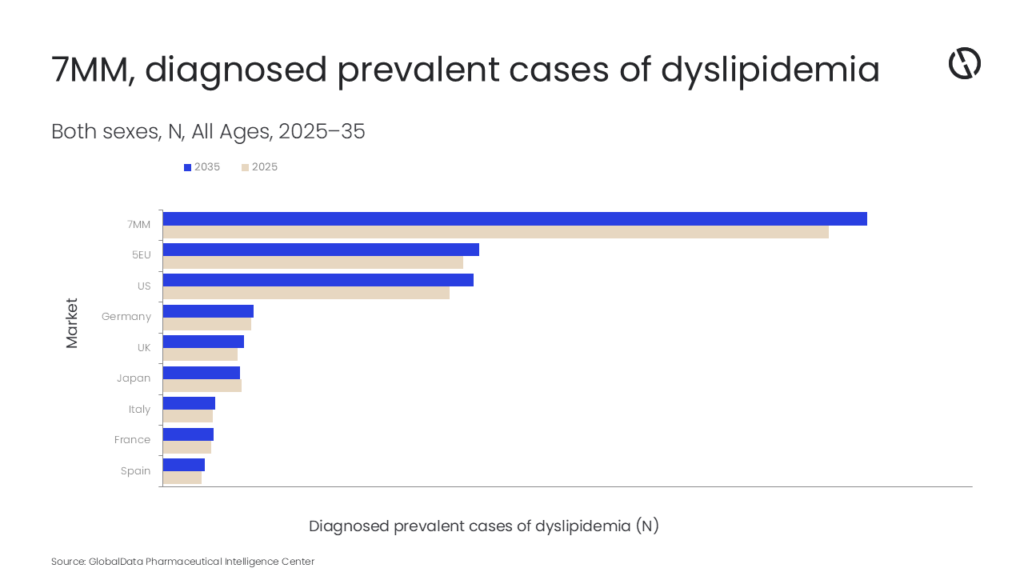
The burden of diagnosed prevalent cases of dyslipidemia in the 7MM is forecast to increase at an annual growth rate (AGR) of 0.58%, from 131.6 million in 2025 to 139.2 million cases in 2035, according to GlobalData, a leading intelligence and productivity platform.
GlobalData’s latest report, “Dyslipidemia: Epidemiology Forecast to 2035,” estimates that the US will have the highest number of diagnosed prevalent cases of dyslipidemia across the 7MM, with just over 61.4 million cases in 2035. Japan and the 5EU** are estimated to have approximately 15.3 million and 62.6 million diagnosed prevalent cases of dyslipidemia in 2035, respectively.
Dyslipidemia is a medical condition characterized by abnormal lipid levels in the bloodstream, and includes the imbalance of cholesterol, low-density lipoprotein cholesterol (LDL-C), triglycerides (TG), and high-density lipoprotein cholesterol (HDL-C).
According to GlobalData epidemiologists, Japan and France were observed to have some of the lowest total and diagnosed prevalence rates of dyslipidemia in the 7MM. This is supported by GlobalData’s Overweight and Obesity: Epidemiology Report and Forecast report, which reports that Japan had the lowest prevalence rates of overweight and obesity in the 7MM, while France had the second lowest rate of overweight and third lowest rate of obesity.
Alia Rafiq, Senior Epidemiologist at GlobalData, comments: “The low prevalence rates of dyslipidemia in Japan and France may be explained by both markets having a lower prevalence of dyslipidemia risk factors, such as obesity. Additionally, studies indicate that Japan has healthier lipid profiles compared to the US and EU markets, as well as a lower prevalence and later onset of cardiovascular disease (CVD). Genetic factors may play a role in this observation, as dysfunctional mutations of cholesteryl ester transfer protein (CETP), which results in high HDL-C frequency, have been observed to be more common in the Japanese population compared than in non-Japanese populations.”
In comparison, GlobalData epidemiologists observed that the UK had the highest AGR of diagnosed prevalent cases of dyslipidemia, as well as the highest diagnosed prevalence rate of dyslipidemia in 2025 among the 7MM.
Rafiq concludes: “The UK has a high prevalence rate of dyslipidemia-related risk factors, including high adherence to the Western diet, limited exercise, and high obesity prevalence. In GlobalData’s Overweight and Obesity: Epidemiology Report and Forecast report, the UK was observed to have the second highest diagnosed prevalence of obesity in the 7MM for 2025.
“Further evidence supporting the UK’s high dyslipidemia burden is its high burden of CVD, with CVD being the leading cause of premature death in the UK, according to NHS data. This is significant, as dyslipidemia is a major risk factor of CVD.”