


































Ministry of Cooperation
Guided by Prime Minister Shri Narendra Modi’s vision of ‘Sahkar se Samriddhi’ and under the leadership of Union Home Minister and Minister of Cooperation Shri Amit Shah, emphasis on accelerating cooperative transformation, institutional strengthening and inclusive growth
Secretary, Ministry of Cooperation, Dr. Ashish Kumar Bhutani calls for strengthening democratic governance, transparency, accountability and good governance across cooperative institutions
Autonomy of cooperative banks must be accompanied by accountability and effective supervision; State Registrars must play a more proactive role: Dr. Bhutani
Recent amendment to the NCDC Act opens new avenues of financial assistance for institutions engaged in promoting cooperative development
States to be consulted on developing a common digital marketing platform for cooperative products and a model cooperative banking framework
Special focus on strengthening value chains in exports, organic products and seeds through national cooperative institutions NCEL, NCOL and BBSSL
Workshop reviews successful State-level initiatives and three-month action plans covering PACS, dairy cooperatives, cooperative banking, digitalisation and business diversification
Two-day Workshop emphasises developing practical models and future strategies for the cooperative sector through exchange of State experiences, challenges and innovations
प्रविष्टि तिथि: 08 OCT 2026 7:24PM by PIB Delhi
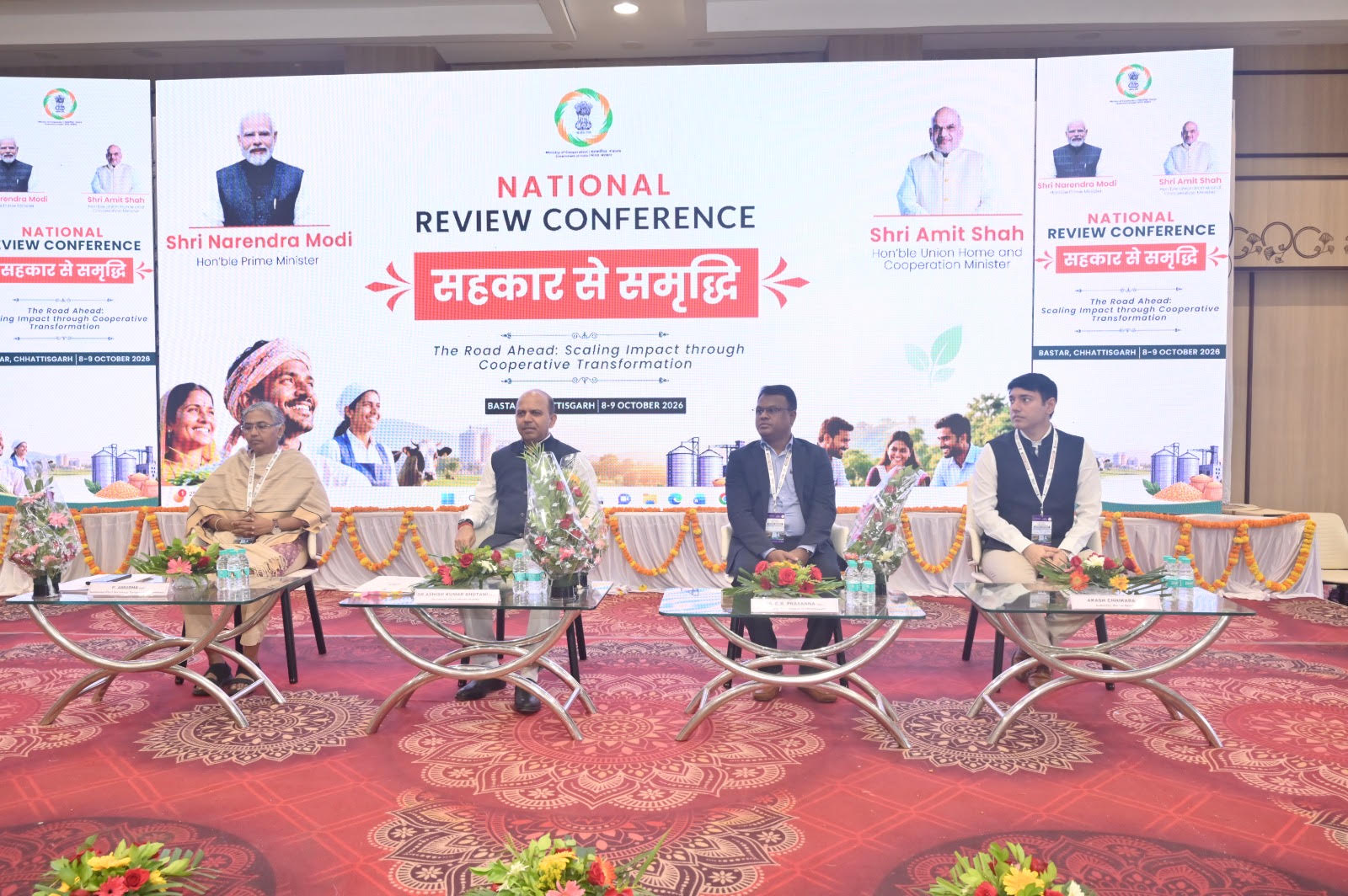
In furtherance of Prime Minister Shri Narendra Modi’s vision of ‘Sahkar se Samriddhi’ and under the leadership of Union Home Minister and Minister of Cooperation Shri Amit Shah, sustained efforts are being undertaken to make India’s cooperative sector stronger, more transparent, accountable and economically vibrant. As part of these efforts, the Ministry of Cooperation is organising the 9th National Review Workshop on 8–9 October 2026 in Bastar, Chhattisgarh, under the theme ‘Sahkar se Samriddhi — The Road Ahead: Scaling Impact through Cooperative Transformation’. The workshop aims to review progress under major cooperative initiatives, facilitate the exchange of successful practices and grassroots experiences among States, and develop outcome-oriented action plans for the next three months. The workshop brings together senior officials from various States, Registrars of Cooperative Societies, representatives of national cooperative institutions and federations, and key stakeholders from across the cooperative ecosystem. The two-day Workshop has been designed as an important platform for State-led deliberations and knowledge-sharing, with detailed discussions focusing on the revival of cooperative institutions, financial strengthening, business diversification, digitalisation, capacity building and improved market access.
Addressing the inaugural session, Secretary, Ministry of Cooperation, Dr. Ashish Kumar Bhutani said that the suggestion to organise this workshop on cooperative development in Bastar, a district that has long been affected by Left Wing Extremism, had come from Union Home Minister and Minister of Cooperation Shri Amit Shah himself, making the initiative particularly significant and meaningful. He emphasised that the objective of the workshop was not merely to discuss various schemes and initiatives, but to translate the experiences and insights gained into concrete action on the ground. Stronger coordination among cooperative institutions, greater institutional collaboration and wider adoption of successful practices would further strengthen the cooperative movement, he said.
Underscoring the need to uphold democratic governance, transparency and the fundamental principles of cooperation at every level, Dr. Bhutani highlighted the vital role played by cooperative institutions in the economic empowerment of small businesses and ordinary citizens, particularly in rural and semi-urban areas. Referring to the cooperative banking sector, Dr. Bhutani said that cooperative banks serve as an important channel for delivering financial services to sections of society that often find it difficult to access adequate credit and other banking facilities from commercial and private banks. He stressed that institutional autonomy must go hand in hand with accountability and effective supervision.
Highlighting shortcomings in the administration and governance of cooperative banks, he called for a more systematic and strategic monitoring framework. He urged Registrars of Cooperative Societies across States to exercise greater vigilance and play a more proactive role in strengthening supervision. Weaknesses in oversight, he cautioned, could have consequences extending beyond individual institutions and adversely affect the credibility of the cooperative sector as a whole.
The Secretary said that the Ministry of Cooperation is working in close coordination with the Reserve Bank of India to strengthen the resource-mobilisation capabilities of cooperative banks and enhance opportunities for providing financial assistance at concessional rates to farmers and other stakeholders associated with the cooperative sector. He also emphasised the need to make cooperative banking more competitive through the adoption of modern technologies, stronger risk management practices and measures to enhance customer confidence.
Highlighting the importance of financial resources for cooperative development, Dr. Bhutani said that the participation of NABARD’s team in the Workshop would provide an opportunity for meaningful deliberations on financing various schemes and institutions. He informed participants that a dedicated session with the National Cooperative Development Corporation (NCDC) had also been scheduled to examine the availability of financial assistance for cooperative initiatives and the specific requirements of States. He noted that NCDC has emerged as a major institution providing financial and institutional support to the cooperative sector over the past two to three years. Referring to the recent amendment to the NCDC Act, he said that it has paved the way for extending financial assistance even to institutions that are not themselves cooperatives but are engaged in promoting cooperative development. This could open new opportunities for various State-level institutions to access financial assistance directly from NCDC. He urged States to make effective use of these opportunities and pursue financing initiatives through stronger coordination.
Highlighting the potential of the dairy sector, Dr. Bhutani said that the workshop would hold detailed deliberations on initiatives undertaken by dairy institutions, opportunities for developing them into cooperative institutions and measures to strengthen associated value chains. Discussions would also cover human resource policies, institutional capacity building, innovation and the emerging requirements of the cooperative sector. The Cooperation Secretary urged all States to share new experiments, successful models and innovations being undertaken in their respective cooperative sectors. He observed that several noteworthy initiatives are being implemented across States, but information about these efforts does not always reach other States. Citing initiatives undertaken by some States in activities related to electric vehicles, he said that sharing such experiences would help build a strong national knowledge base of successful practices and encourage other States to undertake similar innovations.
Referring to the proposal to develop a common cooperative digital platform for more effective marketing of cooperative products and agricultural produce, Dr. Bhutani said that the workshop would examine the progress made under the initiative and the potential role of States in taking it forward. He informed participants that the Open Network for Digital Commerce (ONDC) had also offered its support for the initiative. He said that the Ministry would seek suggestions and guidance from States before proceeding further, with the objective of developing a practical and effective mechanism to connect cooperative institutions with wider markets.
Dr. Ashish Kumar Bhutani emphasised that the deliberations at the workshop had been designed to be more participatory, allowing the Ministry to listen closely to the experiences, concerns and suggestions of States. These inputs would help in developing practical models, guidelines and circulars suited to ground-level requirements. He encouraged States to openly raise challenges relating to the functioning, financing, administration and business expansion of cooperative institutions.
Highlighting the role of Primary Agricultural Credit Societies (PACS) and tribal cooperative institutions, the Secretary Cooperation said that visits to selected cooperative institutions had also been included in the Workshop programme. These visits would provide participants with an opportunity to observe their functioning first-hand and understand practices being adopted at the local level. He stressed the need to link PACS and tribal cooperatives with State and national cooperative federations to improve market access for their products and produce and enable members to secure remunerative prices.
Calling for a closer assessment of government procurement activities undertaken through PACS, Dr. Bhutani said that States where PACS are involved in government procurement should undertake a detailed evaluation of their actual experiences. He urged States to share information on the commissions received by PACS, their real economic gains, delays in payments and the overall financial viability of such activities. He said that successful practices from different States could be consolidated into practical models for wider adoption across the country.
During the inaugural session, Chief Secretary of Chhattisgarh Shri Vikas Sheel welcomed representatives of all participating States and institutions and assured full support from the Government of Chhattisgarh for the development of the cooperative sector. He expressed confidence that the workshop in Bastar would provide fresh impetus to cooperation among States, the exchange of experiences and the development of practical solutions. He said that the suggestions and outcomes emerging from the Workshop would help advance efforts to make cooperative institutions stronger, more transparent, accountable and effective.
On the first day of the workshop, the achievements under major initiatives of the Ministry of Cooperation during the preceding three months were reviewed and progress against national priorities and action plans for the next three months were discussed in detail. These included the formation of multipurpose PACS, computerisation of PACS, the World’s Largest Grain Storage Plan in the cooperative sector, business diversification, cooperative banking and initiatives associated with NCEL, NCOL, BBSSL and NCDC.
During the workshop, thematic sessions were held on ‘Cooperative Growth Story — North Eastern States and Eastern Frontier’ with special attention to cooperative development in Left Wing Extremism-affected districts of Chhattisgarh and Odisha, ‘Cooperative Banking sector and measures to strengthen credit delivery, promote business diversification, adopt new technologies, improve risk management and enhance customer confidence, empowering primary cooperative institutions through national cooperative institutions like National Cooperative Exports Limited (NCEL), National Cooperative Organics Limited (NCOL) and Bharatiya Beej Sahakari Samiti Limited (BBSSL). Discussions also covered strengthening the administrative and business capabilities of cooperative institutions, enhancing benefits for members and creating opportunities for sustainable development, emerging value chains through Multipurpose Primary Cooperatives (MPP) and Multipurpose Cooperative Committees (MCC).
***
AK
(रिलीज़ आईडी: 2320946) आगंतुक पटल : 83